
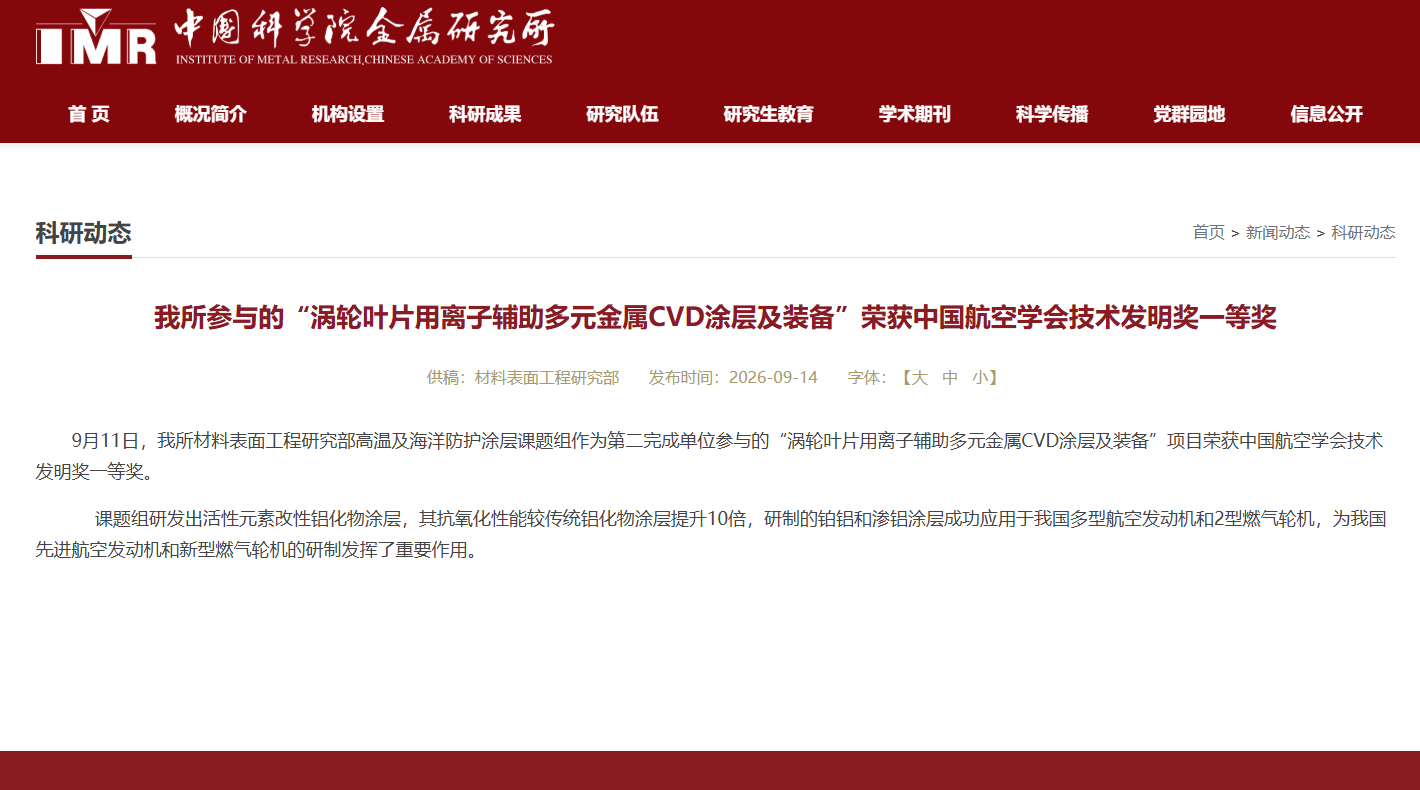
On 9 14, the Institute of Metal Research, Chinese Academy of Sciences, announced results on "ion-assisted multi-element metal CVD coatings and equipment for turbine blades." The team developed an active-element-modified aluminide coating; official reports indicate its oxidation resistance is 10 times higher than traditional aluminide coatings. Platinum-aluminide and pack-aluminide coatings are already used in multiple aircraft engines and 2 gas turbines. While material performance continues to improve, for coatings intended for service in engine hot sections, simply creating them is only the first step. Their ability to withstand long-term oxidation, repeated thermal cycling, temperature gradients, local overheating, and interfacial stress determines whether they can operate reliably.
I. Latest Progress: High-temperature protection for turbine blades continues to advance toward higher temperatures and longer lifespans.
According to a press release from the Institute of Metal Research, Chinese Academy of Sciences on 9/14, the institute's High-Temperature and Marine Protective Coatings Group, as the second completing unit, won the First Prize of the China Aeronautical Society Technical Invention Award for the project "Ion-Assisted Multi-Element Metal CVD Coatings and Equipment for Turbine Blades." Official information confirms that the team developed active-element-modified aluminide coatings and advanced the engineering application of platinum-aluminide and aluminide coatings in aero-engines and gas turbines.
The "10x" multiplier should be interpreted according to the official press release's original context: the statement did not disclose corresponding oxidation temperatures, durations, evaluation metrics, or sample conditions. Therefore, this figure should not be generalized as universally constant across all temperatures and operating conditions. For valid engineering comparisons, parameters such as temperature, cycling protocols, oxidation environment, coating thickness, and failure criteria must be evaluated under identical conditions.
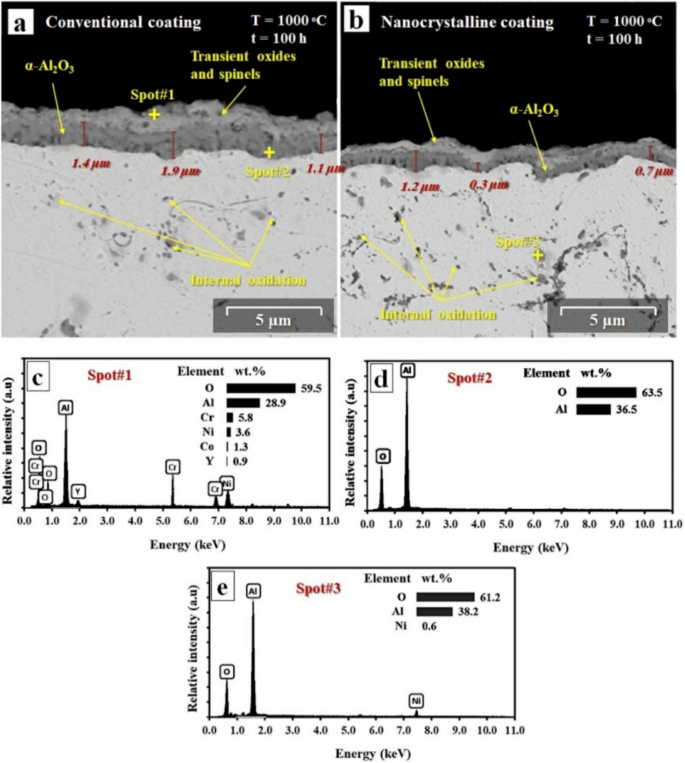
Research on CVD aluminide coatings is supported by published literature. A 202024 study in *Coatings* prepared yttrium-modified aluminide coatings on K444 nickel-based superalloys via CVD, demonstrating that Y addition and deposition conditions influence the formation of the protective α-Al₂O₃ scale and affect high-temperature oxidation and thermal corrosion performance. These findings indicate that "active element modification" does more than simply add a component; it alters the growth rate, integrity, and interfacial stability of the oxide scale.
II. Why is full system validation still necessary if antioxidant performance has improved?
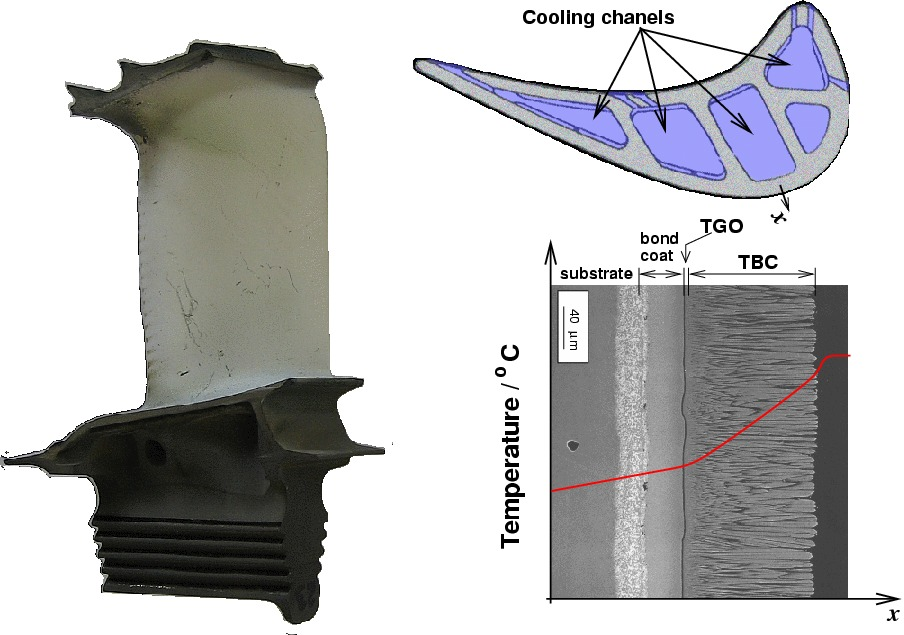
For turbine blade coatings, oxidation resistance is just one dimension of reliability. In actual service, coatings simultaneously face high-temperature oxidation, thermal expansion mismatch, flow erosion, temperature gradients induced by cooling air, and repeated heating/cooling cycles during start-up and shutdown. Good performance in a constant-temperature furnace does not guarantee the same service life under conditions with steep temperature gradients and rapid thermal cycling.
In the complete TBC system, the metallic bond coat must provide oxidation protection and ensure reliable bonding with the ceramic topcoat. At high temperatures, an α-Al₂O₃-dominated TGO forms on the bond coat surface. The TGO must be dense, continuous, and grow slowly; excessive thickening or localized mixed oxidation increases interfacial stress and cracking risk. Due to mismatched coefficients of thermal expansion among the ceramic topcoat, TGO, bond coat, and superalloy, thermal cycling subjects these stresses to repeated loading.
A NiCoCrAlYHf multi-principal element alloy binder layer reported in 2026 in Advanced Science exhibited lower oxidation rates under isothermal conditions at 1200°C for 500 hours. In cyclic oxidation tests, traditional MCrAlY coatings began spalling after 70 hours, with spalled area exceeding 40% by 500 hours, whereas the new alloy showed less than 2% spallation over the same cycle. These results demonstrate that evaluating a binder layer requires more than single weight gain measurements or maximum temperature exposure; oxide adhesion and spallation under cyclic conditions are equally critical.
3. Once the materials are created, you must answer at least four validation questions.
Can the protective oxide film grow stably under prolonged high temperatures at 3.1?
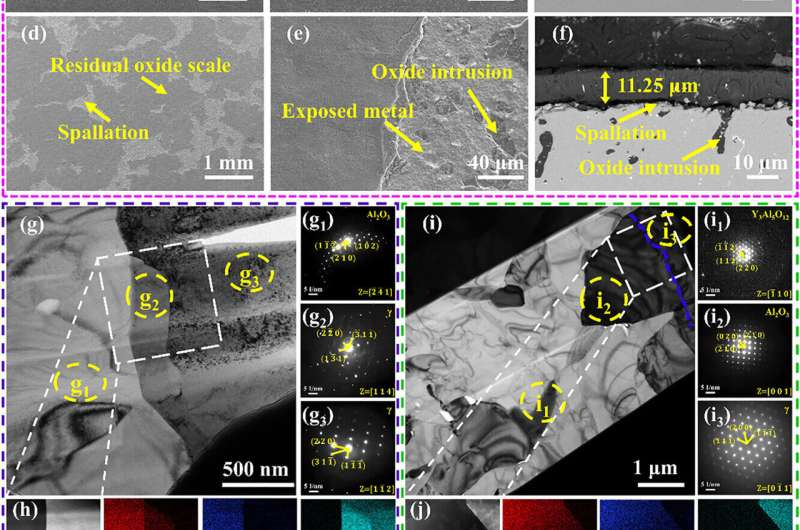
The first layer of validation is typically isothermal oxidation. It focuses on weight gain, TGO growth kinetics, Al depletion, formation of non-protective oxides, and interface integrity. Using mass change measurements, cross-sectional SEM/EDS, and XRD, we can determine whether the protective oxide film remains stable or thickens, develops pores, undergoes internal oxidation, or spalls over time. However, isothermal oxidation serves more as a baseline test for material chemical stability. While essential for understanding oxidation mechanisms, it does not fully represent the cyclic stresses induced by engine start-stop cycles and varying operating conditions.
After 3.2 heating and cooling cycles, will the interface remain intact?
Thermal cycling validation focuses on repeated expansion and contraction. With each heating and cooling cycle, the ceramic topcoat, TGO, bond coat, and substrate experience varying degrees of thermal strain. As cycles accumulate, cracks may initiate at interfaces, propagate, and eventually cause local delamination or large-scale spallation. Therefore, test conditions must clearly specify the maximum/minimum temperatures, heating/cooling rates, dwell time at high temperature, cooling method, number of cycles, and failure criteria. Stating only "Temperature resistance 1150°C" or "1000 cycles" without defining the complete thermal profile provides insufficient information.
Does the failure mode change when there is a temperature gradient in 3.3?
This is the most overlooked yet critical issue in lab validation that closely replicates the real thermal environment of turbine blades. Engine blades do not heat uniformly as a single block: the outer surface is heated by hot combustion gases, while internal cooling channels continuously extract heat. This creates significant temperature gradients both through the coating thickness and across local blade regions.
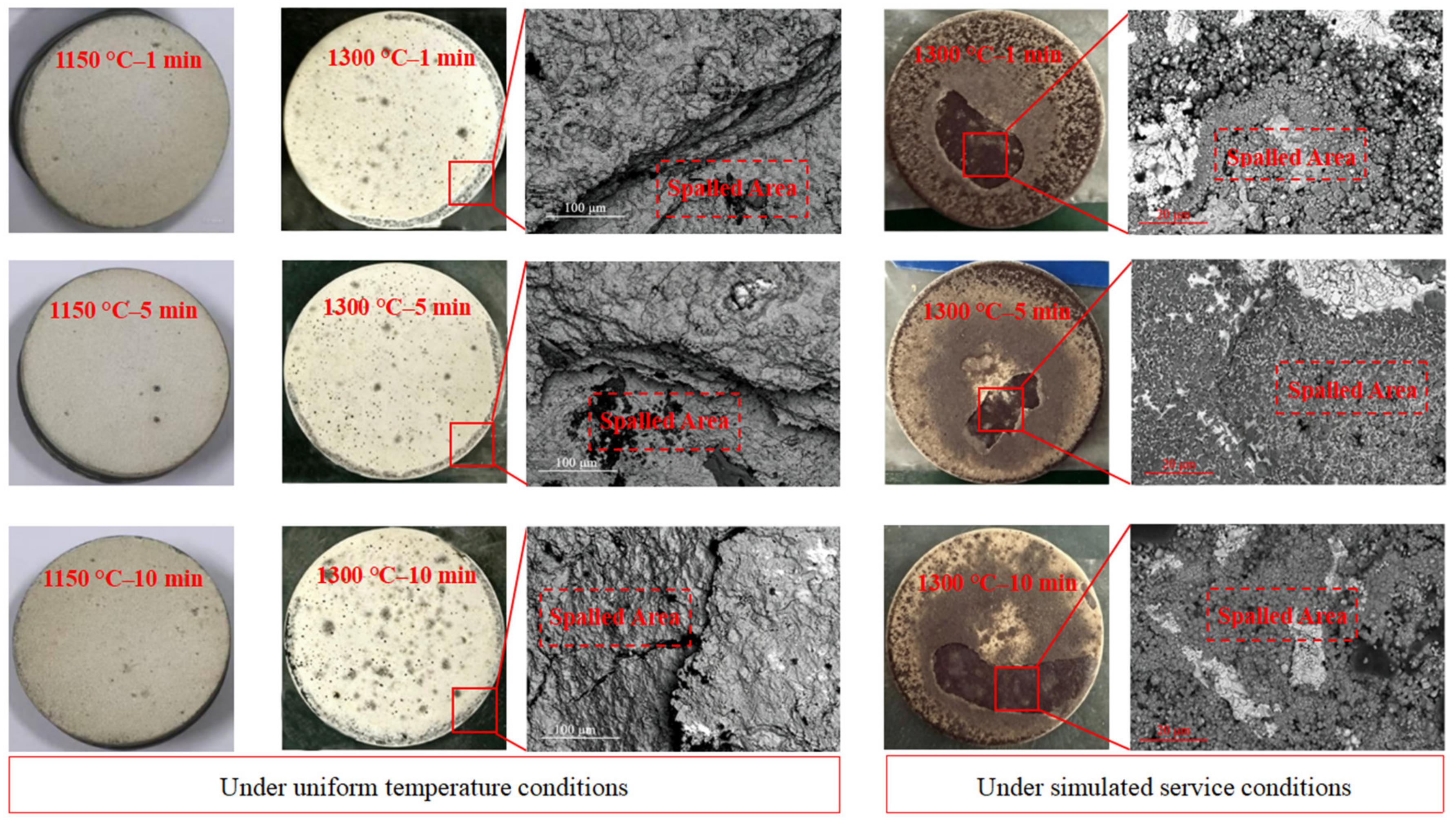
Research from Beihang University, Tianmushan Laboratory, and AECC Shenyang Liming in 2026 provides a direct comparison on this point. The study subjected 8YSZ coating samples to short-term overheating at 1300°C, then tested them under two conditions: "uniform temperature" and "simulated service." Under uniform temperature conditions, the samples failed after 1500 cycles during subsequent thermal cycling at 1150°C. For simulated service conditions—using surface heating with compressed air cooling on the backside (approximately 550°C)—the thermal shock lifetimes following overheat events of 1300°C for 1, 5, and 10 minutes were approximately 41, 30, and 24 cycles, respectively. Failure locations and crack evolution also differed between the two scenarios.
This does not mean all actual blade lifetimes will equal these values, as specimens, coating processes, and boundary conditions differ. It demonstrates instead that temperature gradients and transient thermal stresses can significantly alter the coating's damage path. Therefore, lifetime data obtained from uniform-temperature furnaces cannot directly replace service simulations with heat flux and cooling boundaries without correction.
After 3.4 expires, can you explain why it failed?
Coating validation must go beyond simply recording "failed" or "passed." The true engineering value lies in correlating failure modes with material properties, structural design, and thermal history. For example: Did spallation occur within the ceramic layer or at the ceramic/TGO interface? Is the TGO abnormally thickened? Are there signs of localized oxidation, voids, sintering, longitudinal cracks, or edge stress concentration?
Common methods include surface imaging and spallation area statistics, cross-sectional SEM/EDS, XRD phase analysis, TGO thickness measurement, residual stress characterization, and thermal imaging or non-destructive testing as needed. Only by establishing both "lifespan data" and "failure mechanisms" can test results effectively guide coating formulation, deposition processes, and structural optimization.
IV. Isothermal oxidation, thermal cycling, thermal shock, and temperature gradient: these four validation types are not the same.
| Verification Type | Top Priority | Typical boundary conditions | Questions this is suitable for |
|---|---|---|---|
| Isothermal Oxidation | Oxidation kinetics, TGO growth, Al depletion | Consistent temperature for extended periods | Does the material itself form a stable protective film at high temperatures? |
| Thermal cycling | CTE mismatch, cyclic fatigue, interface cracking/delamination | Repeated cycles of high-temperature holding and cooling | How does the coating lifespan and failure location change after repeated start-stop cycles? |
| Thermal shock / High heat flux | Rapid thermal cycling, transient thermal stress, and localized damage | Rapid heating/cooling with airflow flushing | Do sudden overheating or rapid temperature changes trigger early failures? |
| Temperature Gradient / Service Simulation | Heat flux, front-back surface temperature difference, multi-physics coupling | Surface heating + backside/internal cooling | What is the difference between the uniform temperature test results and the actual blade thermal environment? |
V. Industry Insight: Coating R&D is shifting from "maximum temperature" to "verifiable in-service performance."
Two key developments this year highlight a clear direction: on one hand, metal protective coatings and TBC bond coat materials are continuing to push toward higher-temperature oxidation stability; on the other, evaluation methods are expanding beyond single isothermal oxidation tests to include thermal cycling, thermal shock, temperature gradients, and simulated service environments.
The reason is that the coating on turbine blades is not a static material. Its lifespan is determined by the combined effect of "material properties, coating structure, temperature field, cooling boundaries, and cycle history." Even if two coatings exhibit similar short-term oxidation resistance at the same temperature, they may show vastly different lifespans under cyclic conditions due to differences in TGO growth rate, interfacial bonding, residual stress, ceramic sintering, and crack tolerance.
Reference Materials
- [1] Institute of Metal Research, Chinese Academy of Sciences. Our team's project "Ion-Assisted Multicomponent Metal CVD Coatings and Equipment for Turbine Blades" won the First Prize in Technical Invention from the Chinese Society of Aeronautics and Astronautics. 2026-09-14.
- [2] Yang H., Wu Y., Sun Q., et al. Study on High-Temperature Properties of Yttrium-Modified Aluminide Coating on K444 Alloy via Chemical Vapor Deposition. Coatings, 2024, 14(6): 750.
- [3] Zhang X., Lv W., Wang X., et al. Exceptional 1200 °C Oxidation Resistance in a Novel Multi-Principal Element Alloy via Lattice Distortion–Induced Diffusion Suppression. Advanced Science, 2026, 13: e22526.
- [4] A Review of the Evolution and High-Temperature Degradation Mechanisms of Thermal and Environmental Barrier Coating Systems in Advanced Aero-Engines. Materials, 2026, 19(11): 2413.
- [5] Zhang M., Mou J., Feng Y., et al. Short-Term Overheating Damage Behavior of Thermal Barrier Coatings Under Uniform Temperature and Simulated Service Conditions. Coatings, 2026, 16(8): 919.
- [6] Cracking Behavior of Atmospheric Plasma-Sprayed 8YSZ Thermal Barrier Coatings under Thermal Shock. Coatings, 2023, 13(2): 243.
- [7] A comprehensive study on microstructure evolution and oxidation resistance of conventional and nanocrystalline MCrAlY coatings. Scientific Reports, 2020.