
Product Center
Heating equipment series tailored for research scenarios
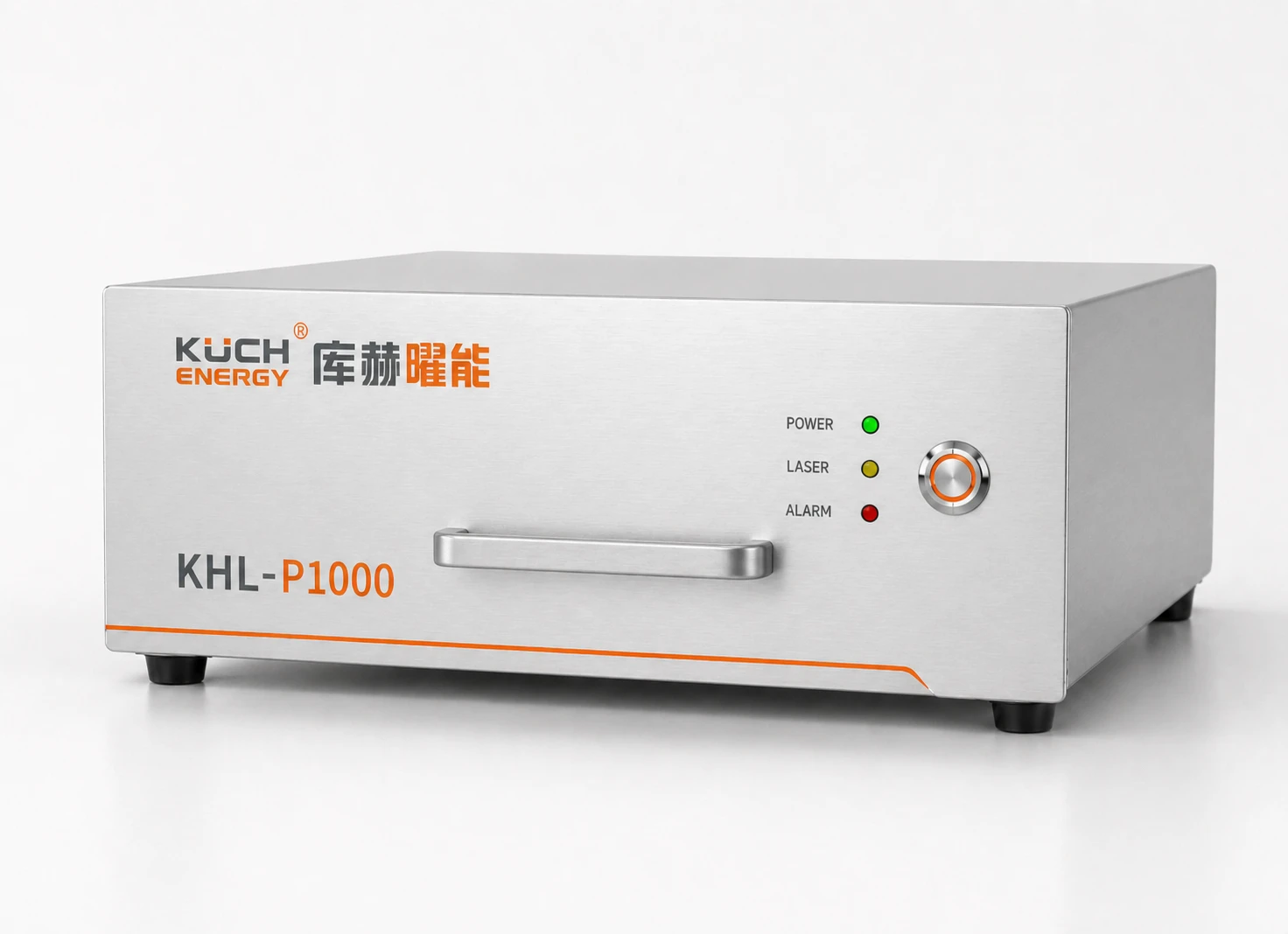
KHL-P1000 Laser Spot Heating System
Product Overview
The KHL-P1000 Laser Spot Heating System is a high-power laser heating solution designed for high-temperature material testing, localized rapid thermal loading, material performance evaluation, and precision heat treatment applications. Featuring a kilowatt-class semiconductor laser source, the system delivers precise energy to target areas via fiber-optic transmission, optical shaping, and focusing technologies. It enables non-contact, high-energy-density, and fast-response localized heating. Compared to traditional furnace methods, laser heating offers a smaller heat-affected zone, faster response times, higher energy efficiency, and seamless integration with closed-loop temperature control. The system can be combined with three-axis motion stages, material testers, and automated test platforms to enable thermo-mechanical coupling and dynamic thermal loading experiments.
Product Positioning
Kilowatt-level laser spot heating
1000 W semiconductor laser delivers energy precisely to the target area via fiber transmission, optical shaping, and focusing. Contactless, high energy density, and fast response.
Thermo-Mechanical Coupling Experiment Platform
Integrates with 3-axis motion stages, material testing machines, and automated test platforms to enable thermo-mechanical coupling and dynamic thermal loading experiments with closed-loop temperature control.
Product Type
How it works
The system employs a kilowatt-level semiconductor laser heat source. Laser energy is transmitted via fiber optics, shaped optically, and focused to precisely deliver heat to the target area. Upon absorbing the light energy, the material rapidly heats up, enabling non-contact, high-energy-density, and fast-response localized heating. The equipment supports both flat-top and Gaussian beam profiles, with configurable circular, rectangular, and homogenized spots. Integrated with infrared thermometers, dual-band pyrometers, or thermal imaging cameras, the temperature detection module enables real-time laser power adjustment, temperature feedback, and experimental program control.
The system comprises five modules: laser heat source, optical focusing, temperature sensing, control, and mechanical integration. It supports continuous output and power modulation modes and can be mounted on a test platform for fixed heating or mobile scanning heating. Compared to traditional resistance furnaces and infrared radiation heating, energy is delivered directly to the target area, achieving higher heat flux density and faster thermal response, while facilitating integration with measurement equipment, high-speed imaging systems, and mechanical testing platforms.
Important Notice:The 500–1500°C temperature range depends on material, absorptance, and operating conditions. Peak temperature can be customized based on application requirements; final projects shall adhere to agreed test conditions and acceptance criteria.
Core Advantages
A high-power point heating system built with kilowatt-level semiconductor lasers transmitted via fiber optics and optically focused, featuring a small heat-affected zone and high energy efficiency. Supports closed-loop temperature control and integrated thermomechanical coupling experiments.
Kilowatt-level laser heat source output
1000 W laser output module for rapid high-temperature heating of metals, ceramics, and composite materials
High-precision Local Hot Reload
Laser energy is concentrated on the target area to achieve millimeter-level precision heating, minimizing thermal impact on non-target regions.
Flexible Spot Configuration
Supports customizable spot sizes and energy distributions, including circular, rectangular, and uniform patterns.
Rapid Dynamic Temperature Control
Integrate infrared thermometry, thermocouples, or thermal imaging systems for temperature feedback control to enhance experimental repeatability.
Modular System Integration
Compatible with 3-axis motion platforms, material testing machines, and automated test systems to enable thermo-mechanical coupling and dynamic thermal loading experiments.
Key Technical Specifications
| Device Model | KHL-P1000 |
| Heating Method | Laser non-contact point heating |
| Laser Power | 1000 W |
| Laser wavelength | 915 nm / 976 nm / 980 nm (configurable) |
| Power adjustment range | 10~100% |
| Spot Size | 2~20 mm (customizable) |
| Energy Distribution | Flat-top beam / Gaussian beam |
| Temperature Range | 500 to 1500°C (varies by material, absorptivity, and operating conditions) |
| Peak Temperature | Customizable to meet application requirements |
| Work Mode | Continuous Output / Power Modulation |
| Output Interface | QBH Fiber Optic Connector (Customizable) |
| Fiber Length | Approx. 10 m (customizable) |
| Cooling Method | Air-cooled or water-cooled |
| Power Requirements | AC 220 V / AC 380 V (as configured) |
| Work Environment | 10~40℃ |
Typical Applications
Experimental Study on Localized Rapid Heating of Superalloys
Thermal Shock Testing for Ceramics and Composite Materials
Thermal cycling, thermal fatigue testing
Localized Annealing and Heat Treatment of Materials
Weld Preheating and Heat-Affected Zone Research
Additive Manufacturing Post-Processing Heat Treatment
Localized heating for semiconductors and electronic components
High-temperature performance testing for research platforms
System Configuration and Control Mode
| Configuration Type | Typical Components | Use Cases |
|---|---|---|
| Basic Power Regulation | Focusing heating head, power controller, cooling assembly, mounting bracket | Process exploration, rapid heating, and experiments with low constant-temperature precision requirements. |
| Closed-loop temperature control | Basic Configuration + Thermocouple or Infrared Temperature Sensor + PID Controller | Target temperature control, heat preservation, over-temperature protection, and repeatability testing |
| Automated Integration Suite | Closed-loop system + 3-axis platform/robotic arm + data acquisition and host computer | Multi-point switching, scan heating, test process linkage, and automatic recording |
Selection Details & Customization Services
Product power, focal length, and control method should be determined jointly based on the sample and test objectives. Before selection, clarify the following information to ensure the spot size, heating rate, and temperature stability meet actual operating conditions:
- Sample material, dimensions, thickness, weight, and surface condition
- Heated zone dimensions, target temperature, allowable ramp-up time, and hold time
- Temperature fluctuation, repeatability, measurement accuracy, and whether temperature curve logging is required
- Fixed-point scanning, multi-position switching, or mobile scanning
- Installation space, working distance, fixture interference, and cooling and safety protection conditions
Available Customizations
- Different power outputs, focal lengths, and target spot sizes
- Fixed, adjustable-angle, or three-axis movable mounting structures
- Thermocouple, Infrared Thermometry, and Dual-Point Verification Solution
- PID closed-loop temperature control, programmable temperature ramping, hold function, and over-temperature protection
- Temperature, Power, and Alarm Data Collection and Export
- Integrate with test machines, robotic arms, fixtures, and automation platforms
Usage and Safety Instructions
- ⚠Strong visible and infrared radiation is emitted during operation. Do not look directly at the light source or focus area. Use appropriate eye and radiation protection equipment.
- ⚠The sample, heating head tip, and surrounding structures may be hot. Install heat guards and allow adequate cooldown time after power-off.
- ⚠Keep the air-cooled channel clear. Do not operate continuously if cooling is abnormal, the reflector surface is contaminated, or electrical connections are loose.
- ⚠Infrared temperature readings are affected by emissivity, angle, and spot size coverage. For highly reflective metals, combine with thermocouples or use a calibrated measurement solution.
- ⚠For adhesives, coatings, and materials that may emit volatiles, evaluate ventilation, smoke extraction, and fire safety conditions.
Product Value
Delivers kilowatt-level laser energy directly to target areas with high heat flux density, rapid thermal response, and high energy efficiency. Provides a complete thermal loading solution for high-temperature material testing, localized rapid thermal loading, and precision heat treatment.
Energy Distribution Diagram
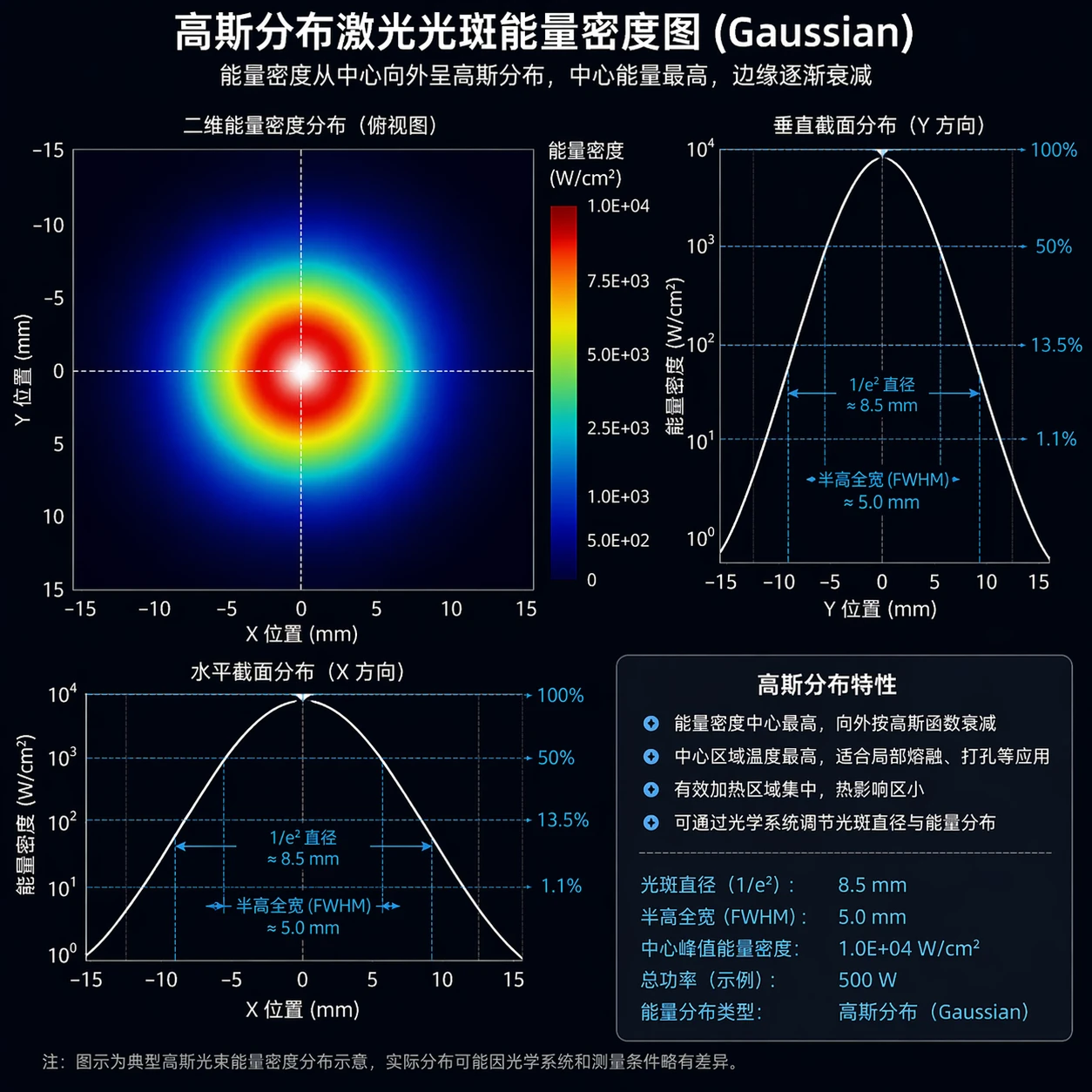
Figure 3Gaussian Beam Energy Density Profile: Energy density follows a Gaussian distribution from the center outward, with peak intensity at the center gradually tapering toward the edges. The central region reaches high temperatures, making it ideal for localized melting and drilling applications with minimal heat-affected zones.
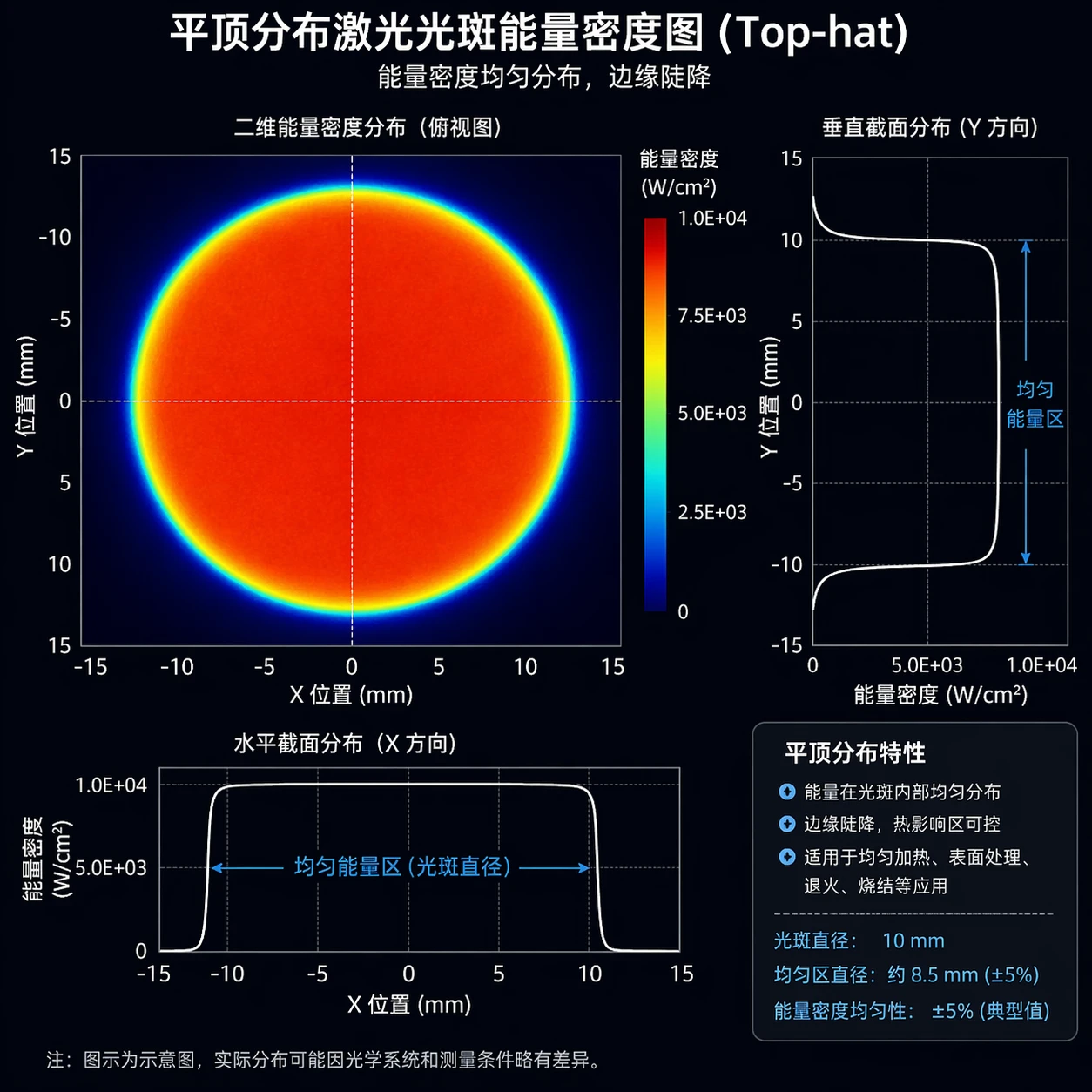
Figure 4Flat-top laser spot energy density map: Energy is uniformly distributed within the spot with a sharp drop-off at the edges. The uniform energy region is controllable, making it ideal for uniform heating, surface treatment, annealing, sintering, and other applications.
Note: The illustration shows a typical beam energy density distribution; actual distributions may vary slightly due to optical system and measurement conditions.