
Product Center
Heating equipment series tailored for research scenarios
Reflective Wide-Spot Laser Heating Head
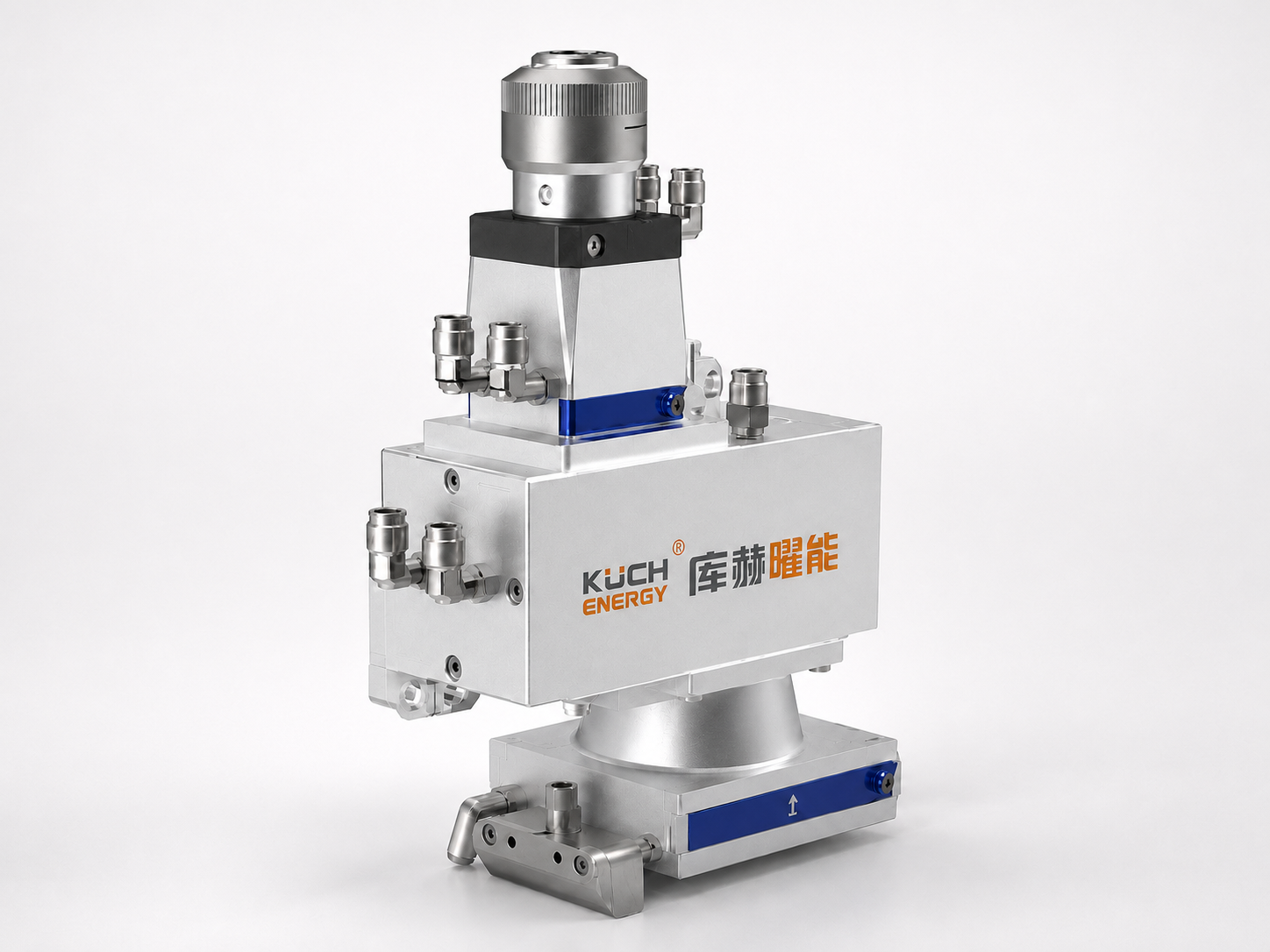
Product Overview
The reflective wide-spot laser heater is designed for high-power thermal loading, high-temperature material testing, thermal shock, thermo-mechanical coupling, composite processing, and automated localized heat treatment. Featuring a reflective large-format optical path, the system converts high-power laser energy into a large, highly uniform heating spot via fiber input, collimation, reflection-based homogenization, focusing/projection, and a front-end protective structure. This enables non-contact, high-response, and precisely controlled heat flux density for regional thermal loading. Unlike cutting or welding heads that prioritize small focal spots and peak power density, this product's core objective is to establish a stable and repeatable large-area temperature field.
Product Positioning
30 kW high-power capacity
Designed for high-average-power continuous laser thermal loading, covering large-area and high heat flux application scenarios.
Large uniform light spot
The reflective homogenization optical path establishes a stable, repeatable large-area uniform temperature field.
Product Type
How it works
High-power continuous laser enters the heating head via QBH, QD, LOE, and other fiber interfaces. A collimator converts the divergent beam from the fiber into a stable collimated beam, which then passes through a reflective homogenization path. Reflective optics redistribute the energy spatial distribution, and a focusing/projection assembly forms a square or rectangular wide spot of the target size at the specified working distance.
The reflective design reduces thermal accumulation in transmissive optics at high average power and enables direct integration of critical mirror assemblies into the water-cooling loop. During heating, a lateral air curtain isolates smoke and volatiles, while upper and lower protective mirrors shield core optics from contaminants, enhancing continuous operation reliability and extending component lifespan.
Important Notice:Beam uniformity depends on beam quality, fiber core diameter, working distance, spot size, and measurement method. For formal projects, acceptance should be based on a beam test report or thermal imaging uniformity results.
Core Advantages
Establish a large-scale uniform temperature field using reflective homogenization optics, balancing high-power continuous operation, optical protection, and modular maintenance.
30 kW high-power handling
Designed for high-average-power continuous-wave laser thermal loading, covering large-area, high heat-flux applications beyond the capabilities of traditional low-power heating heads.
Large uniform illumination spot
Supports large-format spots such as 250 × 250 mm and 450 × 300 mm, ideal for thermal loading on panels, ceramics, composites, and thermal protection specimens.
Beam uniformity up to 95%
Reduce the central energy peak and edge attenuation using a reflective homogenization structure to achieve a more uniform in-plane incident energy distribution across the sample.
Dust-resistant
The upper and lower protective shields, combined with the horizontal air curtain, form a multi-level defense system that minimizes dust and smoke contact with the core lens, preventing contamination or damage.
Modular Maintenance
The lens assembly and protective components feature a modular design for easy installation, cleaning, replacement, and switching between different spot configurations.
High Security and Reliability
The sealed optical path, water-cooled heat dissipation, protective window, and air curtain collectively enhance stability during high-power continuous operation. The system supports interlocks with cooling, access control, over-temperature protection, and motion detection.
Key Technical Specifications
| Maximum Compatible Laser Power | 30 kW |
| Fiber optic interface | QBH, QD, LOE, etc., available for custom laser configurations. |
| Collimating focal length | 150 mm, customizable |
| Focus / Projection Focus | 300 mm, customizable |
| Aperture | φ50 mm |
| Total Weight | ≤8 kg |
| Typical large spot | 250 × 250 mm, 450 × 300 mm |
| Spotlight Mode | Customizable square, rectangular, and other large spot sizes |
| Beam uniformity | Up to 95%* |
| Cooling Method | Water-cooled, multi-loop cooling |
| Optical Protection | Top/Bottom protective glass + horizontal air curtain |
| Maintenance | Modular design with removable, replaceable lenses for easy maintenance. |
Typical Applications
High-intensity heat flux loading
Applies large-area radiative heat flux to panel, shell, or thermal protection specimens for thermal response, heat resistance, and thermal shock evaluation.
High-Temperature Performance Testing of Materials
Rapid heating, constant temperature control, and high-temperature mechanical/physical property testing for superalloys, metals, ceramics, and composites.
Thermo-mechanical coupling test
Integrates with tensile testers, fatigue machines, and other test platforms to establish high-temperature zones synchronously during mechanical load application.
Composite Heating and Forming
Ideal for preheating thermoset composites, assisted hot pressing, curing resin layers, and large-area process heating
Additive Manufacturing Auxiliary Heating
For substrate preheating, inter-layer temperature control, build zone auxiliary heating, and localized post-print thermal treatment
Welding and joining preheat
Rapid preheating for large weld areas or complex structures to reduce thermal gradients and improve process stability.
Automated Scan Hot Reload
Integrate with robots, the XYZ platform, or dedicated machines to enable fixed-area scanning, path scanning, and multi-station heating.
System Configuration and Control Mode
| Configuration Type | Typical Components | Use Cases |
|---|---|---|
| Basic Power Regulation | Focusing heating head, power controller, cooling assembly, mounting bracket | Process exploration, rapid heating, and experiments with low constant-temperature precision requirements. |
| Closed-loop temperature control | Basic Configuration + Thermocouple or Infrared Temperature Sensor + PID Controller | Target temperature control, heat preservation, over-temperature protection, and repeatability testing |
| Automated Integration Suite | Closed-loop system + 3-axis platform/robotic arm + data acquisition and host computer | Multi-point switching, scan heating, test process linkage, and automatic recording |
Selection Details & Customization Services
Product power, focal length, and control method should be determined jointly based on the sample and test objectives. Before selection, clarify the following information to ensure the spot size, heating rate, and temperature stability meet actual operating conditions:
- Sample material, dimensions, thickness, weight, and surface condition
- Heated zone dimensions, target temperature, allowable ramp-up time, and hold time
- Temperature fluctuation, repeatability, measurement accuracy, and whether temperature curve logging is required
- Fixed-point scanning, multi-position switching, or mobile scanning
- Installation space, working distance, fixture interference, and cooling and safety protection conditions
Available Customizations
- Different power outputs, focal lengths, and target spot sizes
- Fixed, adjustable-angle, or three-axis movable mounting structures
- Thermocouple, Infrared Thermometry, and Dual-Point Verification Solution
- PID closed-loop temperature control, programmable temperature ramping, hold function, and over-temperature protection
- Temperature, Power, and Alarm Data Collection and Export
- Integrate with test machines, robotic arms, fixtures, and automation platforms
Usage and Safety Instructions
- ⚠Strong visible and infrared radiation is emitted during operation. Do not look directly at the light source or focus area. Use appropriate eye and radiation protection equipment.
- ⚠The sample, heating head tip, and surrounding structures may be hot. Install heat guards and allow adequate cooldown time after power-off.
- ⚠Keep the air-cooled channel clear. Do not operate continuously if cooling is abnormal, the reflector surface is contaminated, or electrical connections are loose.
- ⚠Infrared temperature readings are affected by emissivity, angle, and spot size coverage. For highly reflective metals, combine with thermocouples or use a calibrated measurement solution.
- ⚠For adhesives, coatings, and materials that may emit volatiles, evaluate ventilation, smoke extraction, and fire safety conditions.
Product Value
Using collimation, reflective homogenization, and projection optics, high-power laser energy is converted into a large-area uniform heat source. This system supports high-power continuous operation, optical protection, and modular maintenance. It is suitable for high-temperature material testing, thermal shock, thermo-mechanical coupling, composite processing, and automated surface heating applications.