
Product Center
Heating equipment series tailored for research scenarios
KHQ-L1000 Quartz Lamp Wire Focusing Heating System
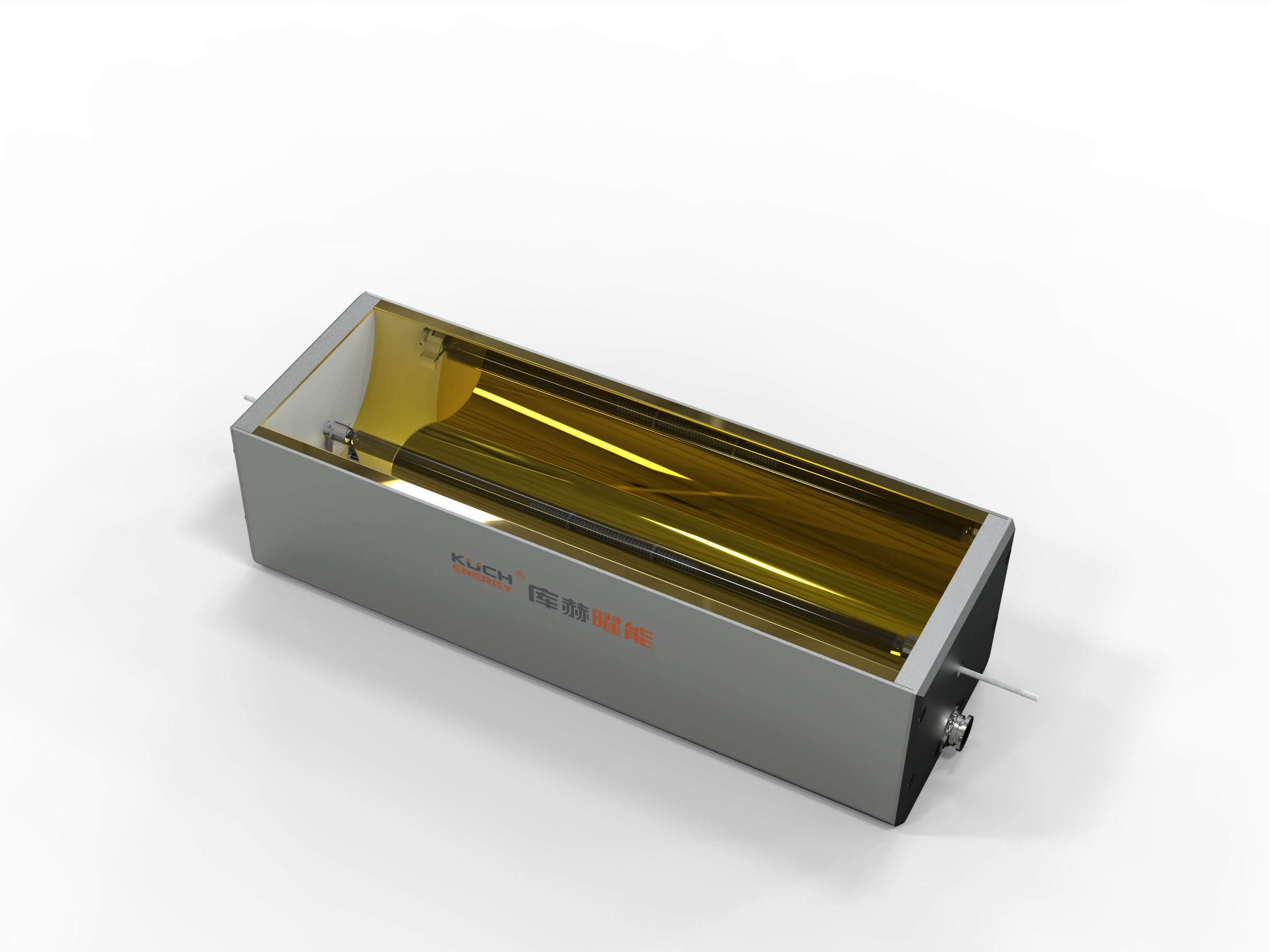
Product Overview
KHQ-L1000 Quartz Line-Focus Heating System is designed for applications including material testing, localized heat treatment, thermo-mechanical coupling, additive manufacturing preheating, and research thermal loading. The system uses high-power quartz-halogen infrared lamps as the heat source. An elliptical-cylinder reflector collects and redistributes radiant energy to create an elongated, high-energy strip on the sample surface along its length, enabling rapid, non-contact, and precisely controlled localized heating. Compared to direct radiation from standard quartz lamps, the line-focus design minimizes energy spread to non-target areas, concentrating available power on the designated heating zone. This increases heat input per unit area in the effective region while reducing unwanted temperature rise in fixtures, sensors, and non-target parts of the sample. The system supports single-lamp operation or multi-lamp, multi-module configurations tailored to heating length, target temperature, heating rate, and number of temperature zones, accommodating scenarios ranging from short-segment local heating to long-strip and multi-zone collaborative thermal loading.
Product Positioning
Striped line-focus hot loading
Elliptical cylindrical reflection focuses infrared radiation into a narrow, high-energy strip, increasing effective thermal input while minimizing the surrounding heat-affected zone.
Modular Multi-Zone Expansion
Single-lamp independent or multi-lamp multi-module combinations, covering localized short-line heating to long-strip and multi-zone collaborative thermal loading scenarios.
Product Type
How it works
When energized, the tungsten filament inside a quartz halogen lamp rapidly reaches high temperatures, emitting continuous radiation dominated by near-infrared and short-wave infrared. The lamp is positioned along one focal line of an elliptical cylindrical reflector. Radiation emitted in all directions is collected by the highly reflective inner wall and re-converged toward the other focal line, creating an elongated strip-shaped heating zone at the specified working distance—significantly longer than it is wide.
For linear thermal loading, system design focuses not merely on increasing lamp rated power, but on comprehensively controlling filament effective emission length, reflector geometry, working distance, heater dimensions, and sample absorption characteristics to deliver sufficient and uniformly distributed radiative power density to the target area.
Important Notice:Temperature, heating rate, temperature control stability, and uniformity depend on the sample material, thickness, surface absorptivity, heated area, working distance, measurement method, and cooling conditions. Final specifications are subject to the agreed test conditions.
Core Advantages
Elliptical cylindrical reflectors focus light into a high-energy strip for rapid thermal response and non-contact heating, with support for multi-lamp and multi-module expansion.
Elliptical cylindrical reflection line focusing
Leverage the geometric focusing properties of an elliptical cylindrical reflector to concentrate infrared radiation emitted in multiple directions from the light source onto a target strip area, thereby increasing effective thermal input and reducing the surrounding heat-affected zone.
Fast thermal response
Quartz halogen lamps have low thermal inertia, enabling rapid radiation output after power-on. They are ideal for applications requiring quick heating, intermittent heating, thermal cycling, and precise control of heat input.
Non-contact local heating
Non-contact heating between the head and specimen reduces contact contamination, fixture interference, and additional mechanical loads, facilitating integration with tensile, fatigue, displacement, and optical measurement systems.
Customizable strip heating zones
Effective heating width and length can be configured based on specimen shape, gauge section dimensions, and target process ranges. Larger areas are achieved by increasing single-lamp power, adding more lamps, or combining multiple modules.
Closed-loop temperature control
Configurable thermocouple or infrared thermometer with real-time lamp output adjustment via PID controller and SCR power regulation unit for heating, holding, program control, and over-temperature protection.
Modular Expansion
Single modules operate independently or combine along the length, across multiple sides, or in multi-zone configurations to create linear heating systems, independent zone temperature control, or scalable planar thermal loading systems.
Key Technical Specifications
| Product Model | KHQ-L1000 |
| Heating Method | Quartz Halogen Lamp Infrared Radiation Focusing |
| Focus Structure | Elliptical Cylindrical Reflected Line Focusing |
| Rated Power per Lamp | Standard 1000 W; 800 W / 1500 W optional |
| Total System Power | Based on the number of lamps, modules, and operating conditions |
| Primary radiation bands | Approx. 0.8–3 μm |
| Effective heating strip width | 20–50 mm, customizable |
| Effective heating length | 100–500 mm, customizable |
| Standard Temperature Capability | Room temperature to 800°C class |
| High-temperature scalability | Scalable to 1200°C under specific multi-lamp/multi-module and sample-adaptation conditions* |
| Typical heating rate | 70–120℃/s |
| Typical steady-state temperature fluctuation | ±2℃* |
| Heating zone temperature uniformity | Typical ≤ ±2%* |
| Temperature Measurement Method | Thermocouple / Infrared Thermometer |
| Temperature Control | PID closed-loop control |
| Power Adjustment | SCR, thyristor, or equivalent power control method |
| Cooling Method | Air-cooled or water-cooled, configured based on power and continuous runtime. |
| Single-module power supply | AC 220 V ±10%, 50 Hz |
| Structure | Single module or combination of multiple modules |
Typical Applications
Localized heat treatment of materials
Preheating, tempering, local annealing, stress relief, and temperature field control for metal sheets, strips, welds, and strip areas.
Thermo-mechanical coupling test
Can be positioned around the gauge section of tensile, fatigue, or creep specimens to apply localized high-temperature loading to narrow working areas while preserving space for grips, extensometers, and optical measurements.
Additive Manufacturing Auxiliary Heating
For localized substrate preheating, forming zone auxiliary heating, inter-layer temperature control, and post-print local heat treatment
Composite Material Machining
Research on Local Softening, Preheating, Curing, and Joining Processes for Thermoplastic Composites
Electronic and Functional Material Testing
Localized non-contact heating, thermal response testing, and process validation for substrates, devices, and functional materials
Glass and Quartz Processing
Narrow-area preheating, forming assistance, and thermal stress control for glass edges, quartz tubes, and thin-walled transparent materials.
Research hot reload
Suitable for temperature gradient, local thermal response, thermal cycling, thermal fatigue, and high-temperature material performance studies
System Configuration and Control Mode
| Configuration Type | Typical Components | Use Cases |
|---|---|---|
| Basic Power Regulation | Focusing heating head, power controller, cooling assembly, mounting bracket | Process exploration, rapid heating, and experiments with low constant-temperature precision requirements. |
| Closed-loop temperature control | Basic Configuration + Thermocouple or Infrared Temperature Sensor + PID Controller | Target temperature control, heat preservation, over-temperature protection, and repeatability testing |
| Automated Integration Suite | Closed-loop system + 3-axis platform/robotic arm + data acquisition and host computer | Multi-point switching, scan heating, test process linkage, and automatic recording |
Selection Details & Customization Services
Product power, focal length, and control method should be determined jointly based on the sample and test objectives. Before selection, clarify the following information to ensure the spot size, heating rate, and temperature stability meet actual operating conditions:
- Sample material, dimensions, thickness, weight, and surface condition
- Heated zone dimensions, target temperature, allowable ramp-up time, and hold time
- Temperature fluctuation, repeatability, measurement accuracy, and whether temperature curve logging is required
- Fixed-point scanning, multi-position switching, or mobile scanning
- Installation space, working distance, fixture interference, and cooling and safety protection conditions
Available Customizations
- Different power outputs, focal lengths, and target spot sizes
- Fixed, adjustable-angle, or three-axis movable mounting structures
- Thermocouple, Infrared Thermometry, and Dual-Point Verification Solution
- PID closed-loop temperature control, programmable temperature ramping, hold function, and over-temperature protection
- Temperature, Power, and Alarm Data Collection and Export
- Integrate with test machines, robotic arms, fixtures, and automation platforms
Usage and Safety Instructions
- ⚠Strong visible and infrared radiation is emitted during operation. Do not look directly at the light source or focus area. Use appropriate eye and radiation protection equipment.
- ⚠The sample, heating head tip, and surrounding structures may be hot. Install heat guards and allow adequate cooldown time after power-off.
- ⚠Keep the air-cooled channel clear. Do not operate continuously if cooling is abnormal, the reflector surface is contaminated, or electrical connections are loose.
- ⚠Infrared temperature readings are affected by emissivity, angle, and spot size coverage. For highly reflective metals, combine with thermocouples or use a calibrated measurement solution.
- ⚠For adhesives, coatings, and materials that may emit volatiles, evaluate ventilation, smoke extraction, and fire safety conditions.
Product Value
Powered by high-power quartz halogen infrared lamps, an elliptical cylindrical reflector focuses the heat into a narrow, elongated high-energy zone on the sample surface. This enables rapid, non-contact, and controllable localized thermal loading for material testing, thermo-mechanical coupling studies, additive manufacturing assist heating, and scientific research applications.