
Quartz Lamp Thermal Fatigue Testing Machine
Uses quartz lamp radiant heating and water-cooled rapid cooling, combined with an automatic lifting mechanism, to perform thermal fatigue cycling tests on metal sheets, meeting the HB 6660—2011 standard requirements.
Project Challenges
Metal sheets undergo repeated heating and rapid cooling during service, requiring simulation of cyclic thermal stress conditions to observe damage evolution under thermal cycling.
Use Device
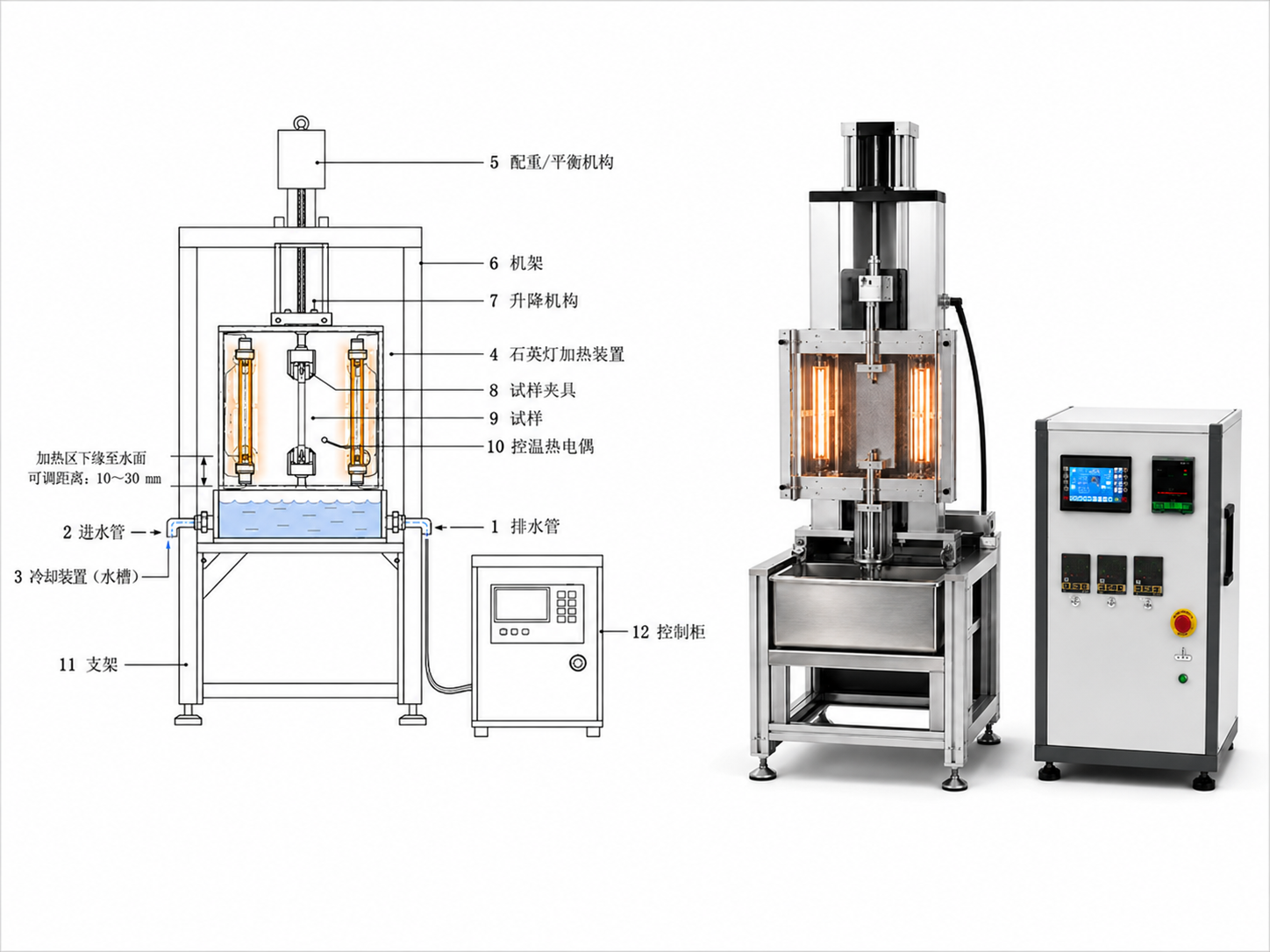
Quartz lamp radiant heating module, specimen fixture and lifting mechanism, water-cooled cooling system, temperature measurement system, PLC touch screen control system
Project Outcomes
Successfully implemented a thermal fatigue cycling test system combining quartz lamp radiant heating and water-cooling rapid cooling. Maximum temperature: 1100°C, compliant with HB 6660—2011 standards.
Case Details
Customers do not need a single heating device; they require a thermal fatigue testing system capable of performing a "heat-cool-reatt" cycle. The equipment should simulate the operating conditions of metal sheets or similar materials undergoing repeated heating and rapid cooling during service, inducing alternating thermal stresses on the specimen surface to observe material damage evolution under thermal cycling.
This solution uses quartz lamp radiation as the primary heat source. Quartz lamps offer non-contact heating, fast response, customizable heating zones, and minimal sample contamination, making them ideal for rapid localized heating of plate specimens. Combined with a water-cooled cooling zone and an automatic lifting mechanism, they enable stable and repeatable thermal cycling.
1. Design Basis and Scope of Application
This design references the structural logic of thermal fatigue testing machines outlined in HB 6660—2011 "Test Method for Thermal Fatigue of Metal Sheets," retaining core functions such as heating, cooling, specimen clamping, lifting mechanisms, temperature-control thermocouples, water inlet/outlet piping, frames, and control systems. The key distinction is that this方案 replaces traditional electric furnace heating with quartz lamp radiant heating. Based on actual specimen dimensions, target temperatures, and cycle requirements provided by customers, the heating zone size, cooling method, clamp structure, and control system can be customized accordingly.
This equipment is designed for thermal fatigue testing of rectangular plate specimens and similar structures. Typical applications include hot-section materials in aircraft engines, high-temperature alloy sheets, thermal protection structural materials, welded or coated specimens, as well as material selection and process validation under thermal cycling conditions. For non-standard or irregularly shaped specimens, the system can be extended by swapping in dedicated fixtures and localized heating modules.
2. Device Implementation and Test Results
| Device Implementation Details | Test effect correspondence | Results available |
|---|---|---|
| Quartz lamp radiant heating | Rapidly and non-contact heat a specified region of the sample to create a stable high-temperature zone. | Sample upper temperature limit, heating ramp-up, and holding state |
| Water-cooled rapid cooling | After heating, the sample enters the cooling zone to achieve rapid temperature reduction, creating thermal shock/cycling conditions. | Cool-down time, lower temperature limit, heating-cooling cycle stability |
| Auto-lift circulation | The specimen automatically reciprocates between the heating and cooling zones. | Cumulative cycle count, Single cycle duration, Test termination record |
| Temperature Acquisition and Control | Monitor sample temperature and control heating output | Temperature-Time Curve, Temperature Fluctuation Log, Test Data Export |
| Crack Observation and Life Assessment | Observe crack initiation and propagation in the specimen during or after the cyclic process. | Cycle count for crack initiation, cycle count corresponding to specified crack length, thermal fatigue life comparison |
III. Overall Equipment Solution
The equipment features a vertical frame structure. Once the specimen is mounted in a dedicated fixture, a lifting mechanism moves it between the heating and cooling zones. During the heating phase, quartz lamps radiate heat to the specimen's local or specified area. In the cooling phase, a water-cooling tank rapidly cools the specimen.
The control system uses a PLC and touchscreen as the core to manage quartz lamp output, lifting/lowering actions, cooling circulation, temperature acquisition, and cycle counting. The equipment supports both manual debugging mode for initial process parameter tuning and automatic test mode for stable long-term operation during formal trials.
IV. Key Technical Specifications
| Project | Parameters |
|---|---|
| Specimen Type | Metal sheets, thin sheets, rectangular plate specimens |
| Heating Method | Quartz lamp radiant heating |
| Maximum heating temperature | 1100℃ |
| Temperature control accuracy | ±2℃ |
| Heating Zone Dimensions | Customizable |
| Cooling Method | liquid cooling |
| Lift Stroke | 100~300 mm (customizable) |
| Lift speed | Adjustable |
| Iteration count | 1 to 999999 times can be set |
| Control Mode | PLC + HMI with manual/automatic mode switching |
| Data Records | Records of basic data such as temperature, duration, and cycle count. Optional PC export. |
| Security Protection | Over-temperature, low water level, limit switch, emergency stop, leakage, and fault alarm protection |
| Temperature Measurement | Thermocouple or infrared temperature measurement |
| Power | AC 220 V / 50 Hz |
| Device Dimensions (Reference) | Approx. 800 mm × 600 mm × 1200 mm |
5. Key Components and Functional Overview
5.1 Quartz Lamp Radiation Heating Module
The quartz lamp heating module provides non-contact radiative heating to a specified area of the sample. The number and power of the quartz lamps can be configured based on sample width, target heating zone, and desired temperature. Heating performance is further optimized by adjusting lamp spacing, reflective/insulating structures, and sample positioning. Compared to conventional electric furnaces that enclose the entire sample, the quartz lamp system offers faster response times and is ideal for establishing pronounced heating-cooling thermal cycles.
5.2 Specimen Clamping and Automatic Lifting Mechanism
The specimen fixture holds rectangular plate specimens and exposes the heated zone. An automatic lifting mechanism moves the specimen back and forth between the quartz lamp heating zone and the water-cooling zone. Lift position, dwell time, and cycle count are configurable via the touchscreen. During operation, upper/lower limit switches and position sensors ensure reliable movement.
5.3 Water-cooled cooling system
The cooling system consists of a water trough, inlet pipe, drain pipe, water level adjustment mechanism, and circulation water interface. After heating, the specimen enters the cooling zone for rapid temperature reduction via water cooling. For applications requiring high consistency in cooling conditions, a circulating water tank or constant-temperature cooling unit can be configured to ensure stable cooling across different test batches.
5.4 Temperature Measurement and Data Acquisition System
The device supports temperature measurement via thermocouples, with optional infrared sensors based on sample conditions. Thermocouples are ideal for standardized temperature control and process logging, while infrared sensors enable non-contact monitoring of the sample surface. The system records key parameters such as sample temperature, heating duration, cooling time, and cycle count to generate temperature-time curves and support test process traceability.
5.5 Electrical Control and Safety Protection
The control system is built around a PLC and HMI to handle parameter setup, automatic cycling, process visualization, data logging, and alarm interlocks. Safety protections include over-temperature, low water level/empty tank, lift limit, emergency stop, and ground fault protection, ensuring safety and stability during continuous cyclic testing.
VI. Typical Test Process
- Specimen Preparation: Prepare rectangular plate specimens according to test requirements. Clean the specimen surfaces to remove oil, scale, and obvious burrs. Based on the test objective, mark observation areas on the specimen surface in advance to facilitate subsequent recording of crack initiation sites, crack length, and propagation direction.
- Sample Installation: Secure the sample in a dedicated fixture, ensuring it is centered within the quartz lamp heating module. Ensure the sample is held firmly and positioned vertically to prevent shifting or vibration during vertical movement cycles. Position the temperature control thermocouple near the heating zone or at a designated spot on the sample surface for real-time temperature feedback.
- Parameter Settings: Configure test parameters on the touchscreen interface, including target heating temperature, dwell time, cooling duration, lift speed, cycle count, and temperature safety limit. Based on material type and test requirements, adjust quartz lamp power output, lift stroke, and cooling water level to maintain a close distance between the heating zone and the cooling water surface.
- Heating Phase: Upon test initiation, the lifting mechanism moves the specimen into the quartz lamp heating zone. Once activated, the quartz lamps rapidly radiate heat to the designated area of the specimen, causing its temperature to rise over time. The system continuously monitors the specimen temperature via thermocouples. When the target temperature is reached or the preset heating duration expires, the process proceeds to the next step.
- Rapid Transfer Phase: Immediately after heating completes, the lifting mechanism activates to move the specimen from the heating zone down to a nearby water-cooled zone. With the cooling tank positioned directly beneath the quartz lamp heating module at close proximity, this design minimizes the transition time from high temperature to cooling, thereby enhancing thermal cycling shock performance.
- Water Cooling Stage: Upon entering the water-cooling zone, the specimen contacts cooling water and cools rapidly. During this phase, the system maintains the set cooling duration while water is replenished or circulated via inlet and outlet pipes to ensure stable water levels and consistent cooling performance. After cooling, the lifting mechanism returns the specimen to the quartz lamp heating zone.
- Cycle Test: The equipment automatically cycles through the sequence "heating → cooling → water cooling → rising." Upon completion of each heating and cooling cycle, the system automatically records the cycle count along with temperature changes, heating duration, cooling duration, and other relevant data. The cycling continues until the preset number of cycles is reached or termination conditions—such as specified cracking or fracture in the specimen—are met.
- Test Observation and Recording: During the test, you can pause at set cycle intervals to inspect the specimen surface. Record whether cracks appear, their initiation location, length, and propagation direction. Use a magnifying glass, microscope, or image capture device as needed for closer inspection.
- Test End: The equipment automatically stops once the set number of cycles is reached or the specimen reaches a defined failure state. Turn off the quartz lamp heating module and cooling system. Once the specimen temperature drops to a safe range, remove it for subsequent crack measurement, fracture analysis, or performance evaluation.
- Data Organization: Upon completion of the test, organize the temperature–time curve, cycle count, cycles to crack initiation, crack propagation details, and final failure status. These data are used to evaluate the material's thermal fatigue life, resistance, and crack propagation characteristics under thermal cycling conditions.
VII. Configuration List
| No. | Configuration Name | Primary Function |
|---|---|---|
| 1 | Device Host Frame | Supports heating module, lifting mechanism, water cooling system, and control components |
| 2 | Quartz Lamp Radiant Heating Module | Rapidly heat the specified area of the test specimen |
| 3 | Specimen Fixture and Lifting Mechanism | Secure the specimen and automatically switch between heating and cooling zones. |
| 4 | Water-cooled cooling trough and piping | Achieve rapid sample cooling and water circulation drainage |
| 5 | Temperature Measurement System | Monitor specimen temperature and heating process; generate temperature records. |
| 6 | PLC HMI Control System | Complete parameter setup, automatic cycling, counting, and alarm interlock |
| 7 | Security Protection System | Includes over-temperature, low-water, limit, emergency stop, and electrical protection. |
VIII. Solution Summary
This solution utilizes quartz lamp radiation heating, water-cooled rapid cooling, and an automatic lifting-cycling structure to address key challenges in thermal fatigue testing: ensuring stable, repeatable heating–cooling cycles; accurately recording cycle data; and obtaining reliable material thermal fatigue evaluation results. With its clear equipment design and intuitive test workflow, it is well-suited for standard thermal fatigue tests, comparative material process trials, and R&D-stage thermal cycling damage assessments.
Need something similar?
Our technical team delivers customized laser heating solutions tailored to your specific needs.
Contact Us