
200 0W Laser Uniform Area Thermal Ceramic Surface Cleaning System
Through proprietary optical design and in-house developed homogenization lenses, the 2000W laser is shaped into a 50mm × 50mm square uniform spot, creating a stable, controllable surface heat source on ceramic. This enables non-contact, high-efficiency, and highly consistent surface cleaning and coating removal.
Project Challenges
Traditional sandblasting, chemical cleaning, and mechanical grinding on ceramic surfaces often cause substrate damage and poor consistency during the removal of contaminants, oxide layers, and residual coatings. Direct Gaussian laser irradiation, meanwhile, risks central overheating, insufficient edge cleaning, and microcracks from thermal shock.
Use Device
2000W laser, proprietary homogenizing optics, beam collimation and expansion shaping module, infrared temperature measurement/thermal imaging feedback system, motion platform and fixtures, dust extraction and protection structure, laser power adjustment and temperature feedback control system
Project Outcomes
The proprietary homogenizing lens shapes the 2000W laser into a 50mm × 50mm square flat-top beam, achieving temperature uniformity up to 98% across the effective area. This enables non-contact, highly consistent ceramic surface cleaning, coating removal, and oxide layer elimination with repeatable processes and sharp boundaries.
Case Details
Ceramic materials are renowned for their high-temperature resistance, corrosion resistance, hardness, and chemical stability. They are widely used in aerospace, semiconductors, electronic packaging, new energy, precision manufacturing, and high-temperature structural components. During processing, service, or remanufacturing of ceramic parts, surface issues such as contaminants, oxide layers, residual coatings, sintering residues, and carbonized oil films may occur.
Traditional cleaning methods such as sandblasting, chemical cleaning, and mechanical grinding often cause substrate damage, uneven cleaning, residual contaminants, and poor process consistency. To address these challenges, we have developed the 2000W Laser Uniform Area Thermal Cleaning System. Featuring proprietary optical design and a self-developed beam homogenizer, this system shapes the laser into a 50mm × 50mm square uniform spot. This creates a stable, controllable, and uniform surface heat source on ceramic materials, enabling non-contact, high-efficiency, and highly consistent surface cleaning.
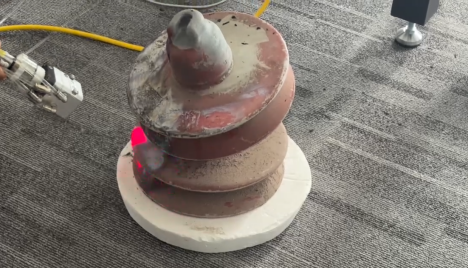
1. Project Core Parameters
| Project | Parameters |
|---|---|
| Laser Power | 2000 W |
| Spotlight Mode | Square uniform spot |
| Spot Size | 50 mm × 50 mm |
| Heating/Cleaning Method | Non-contact laser face hardening |
| Optical Solution | Self-developed homogenizing optical lens |
| Control Mode | Laser Power Adjustment + Temperature Feedback Control |
| Target Audience | Ceramic parts, ceramic coatings, oxide layers, contamination layers, and residue removal |
Note: This case study focuses on the implementation and process value of uniform laser areal heating. The actual surface temperature of the ceramic depends on the material, surface condition, absorptivity, cleaning speed, fixture heat dissipation, and measurement method. Final values should be based on on-site measurements and process validation.
II. Why Uniform Area Heating Is Essential for Cleaning Ceramic Surfaces
Conventional laser output typically follows a Gaussian distribution, with higher energy at the center and lower energy at the edges. Direct application to ceramic surface cleaning can cause overheating in the center, insufficient energy at the edges, residual contamination along the boundaries, and poor batch-to-batch consistency.
For ceramics, excessive local energy can cause thermal shock, micro-cracks, chipping, or surface ablation, while insufficient edge energy may leave contaminants behind. Therefore, the key to laser cleaning of ceramic surfaces is not simply increasing power, but converting laser energy into a controllable, uniform, and stable area heat source.
3. Solution: In-house optical lens achieves uniform surface heating of 50×50 mm
This case does not use traditional circular Gaussian beam direct irradiation. Instead, through proprietary optical design, the 2000W laser is shaped into a uniform square spot of 50mm × 50mm. The overall technical approach is as follows:
- Laser Output: Delivers stable, high-power laser energy
- Beam Collimation: Optimize beam divergence and propagation direction
- Beam Expansion and Shaping: Match the beam size to the rear homogenizing lens.
- Custom-designed homogenization lens: redistributes energy to achieve a flat-top beam profile.
- Square spot projection: Creates a uniform processing area of 50mm × 50mm on the ceramic surface.
- Process Feedback Control: Achieve stable processing by integrating temperature monitoring, motion control, and power adjustment.
The self-developed homogenizing optical lens is the core of this solution. Designed based on laser power, target spot size, working distance, ceramic surface condition, and cleaning process requirements, it does more than simply expand the beam. It redistributes laser energy to transform a beam with high intensity at the center and low intensity at the edges into a uniform spot ideal for surface treatment.
4. Core Role of Self-Developed Optical Lenses
- Convert Gaussian distribution to flat-top: Redistribute laser energy for a flatter profile in the target area, addressing issues like central overheating and insufficient edge treatment.
- Enhance edge energy compensation: Compensate for heat diffusion and cooling effects at the edges to ensure stable processing in the spot boundary region, minimize edge residue, and improve overall cleaning consistency.
- Tailored to actual equipment installation space: Custom-designed based on equipment footprint, working distance, and cleaning area; seamlessly integrated with motion platforms, fixtures, vacuum systems, temperature monitoring systems, and protective structures.
5. Temperature Uniformity Evaluation
This system prioritizes temperature and cleaning uniformity across the effective area over single-point peak temperatures. Traditional laser spots exhibit a Gaussian energy distribution—high at the center and low at the edges—which can cause overheating in the center and insufficient treatment at the periphery, compromising cleaning consistency and ceramic surface quality.
This system uses a proprietary homogenizing optical lens to redistribute laser energy, creating a near-flat-top thermal field across an effective spot area of 50×50 mm. This ensures more uniform energy distribution at the center, edges, and corners of the spot, thereby improving heating uniformity on the ceramic surface.
Regional statistical analysis shows that temperature uniformity within the effective spot area reaches 98%. The 2D temperature distribution map displays consistent coloration across the main spot region, while the 3D map reveals a near-flat-topped profile. X/Y cross-sectional centerline curves remain stable overall, indicating minimal temperature differences between the center, edges, and corners. This performance meets requirements for ceramic surface cleaning, coating removal, oxide layer elimination, and high-uniformity flat-surface heat treatment.
6. Case Results
When using this system to clean ceramic components, the laser no longer targets the material with single-point high energy. Instead, it uniformly heats and covers the target area. Compared to traditional point-based laser cleaning, this approach offers superior coverage, cleaning consistency, and process repeatability.
- Larger cleaning area: The 50mm × 50mm square spot covers a wider processing area per pass, ideal for cleaning ceramic flat parts, ceramic sheets, and regular surface areas.
- More uniform cleaning: Optical homogenization design prevents over-cleaning at the center and under-cleaning at the edges.
- More friendly to ceramic substrates: Uniform surface heating reduces the risk of thermal shock caused by localized energy concentration.
- Sharper cleaning boundaries: Square light spots align more precisely with workpiece edges, cleaning paths, and automated motion trajectories.
- Improved process repeatability: The system integrates with motion platforms, infrared thermometers, thermal imagers, and automated control systems to enable parameterized, programmatic, and repeatable control.
7. Technical Highlights
| Highlights | Instructions |
|---|---|
| High-Power Laser Surface Heating Output | Uses a 2000W laser as the heat source for fast response, concentrated energy, and non-contact processing—ideal for rapid cleaning and pretreatment of ceramic surfaces. |
| 50×50 mm square uniform spot | Our proprietary optical lens reshapes the laser into a uniform square spot, ideal for cleaning ceramic surfaces, removing coatings, and localized heat treatment. |
| Autonomous optical design capability | Autonomously design optical lenses to meet diverse operating conditions, delivering laser sheet heating outputs with varying dimensions, shapes, and working distances. |
| Flat energy distribution | Optimizes the traditional Gaussian distribution into a flatter energy profile via optical homogenization, ensuring more uniform heating of the ceramic surface. |
| Integrable temperature feedback control | Works with infrared thermometers, thermal cameras, or multi-point temperature monitoring systems to enable laser power adjustment and cleaning process monitoring. |
8. Use Cases
- Ceramic Surface Cleaning: Remove oil, carbon deposits, dust, and sintering residues.
- Ceramic Coating Removal: For localized stripping, removal of failed coatings, and surface preparation prior to remanufacturing
- Oxide and Contaminant Removal: Surface treatment for ceramic components after high-temperature service
- Ceramic Surface Activation: Pre-treatment for bonding, coating, and encapsulation.
- Semiconductor Ceramic Part Cleaning: Precision surface treatment for ceramic components including alumina, aluminum nitride, and silicon carbide.
- Surface heat treatment for high-temperature materials: suitable for ceramic matrix composites, thermal barrier coatings, and high-temp insulating components under surface thermal loading.
IX. Project Summary
Our laser uniform area thermal cleaning system, developed in-house, features proprietary optical design and self-developed homogenization lenses. It transforms traditional Gaussian-distributed laser beams into uniform spots, creating a stable, controllable, and highly consistent surface heat source on ceramic substrates. Unlike conventional laser point cleaning, our system's core advantage lies in uniform surface heating. Through optical homogenization, it converts the energy distribution from a Gaussian profile (high at the center, low at the edges) to a near-top-hat uniform distribution. This effectively eliminates issues such as central overheating and edge under-cleaning, ensuring more consistent ceramic surface cleaning results.
The system offers optical customization based on ceramic part dimensions, surface conditions, cleaning zones, and process requirements. It supports various spot shapes, including square and rectangular, and integrates with infrared thermometry, thermal imaging, motion platforms, and automated control systems to enable applications such as ceramic surface cleaning, coating removal, oxide layer removal, surface activation, and high-temperature material surface treatment.
Need something similar?
Our technical team delivers customized laser heating solutions tailored to your specific needs.
Contact Us