
Multi-Specimen Cycling Temperature Control Test System for Quartz Lamps
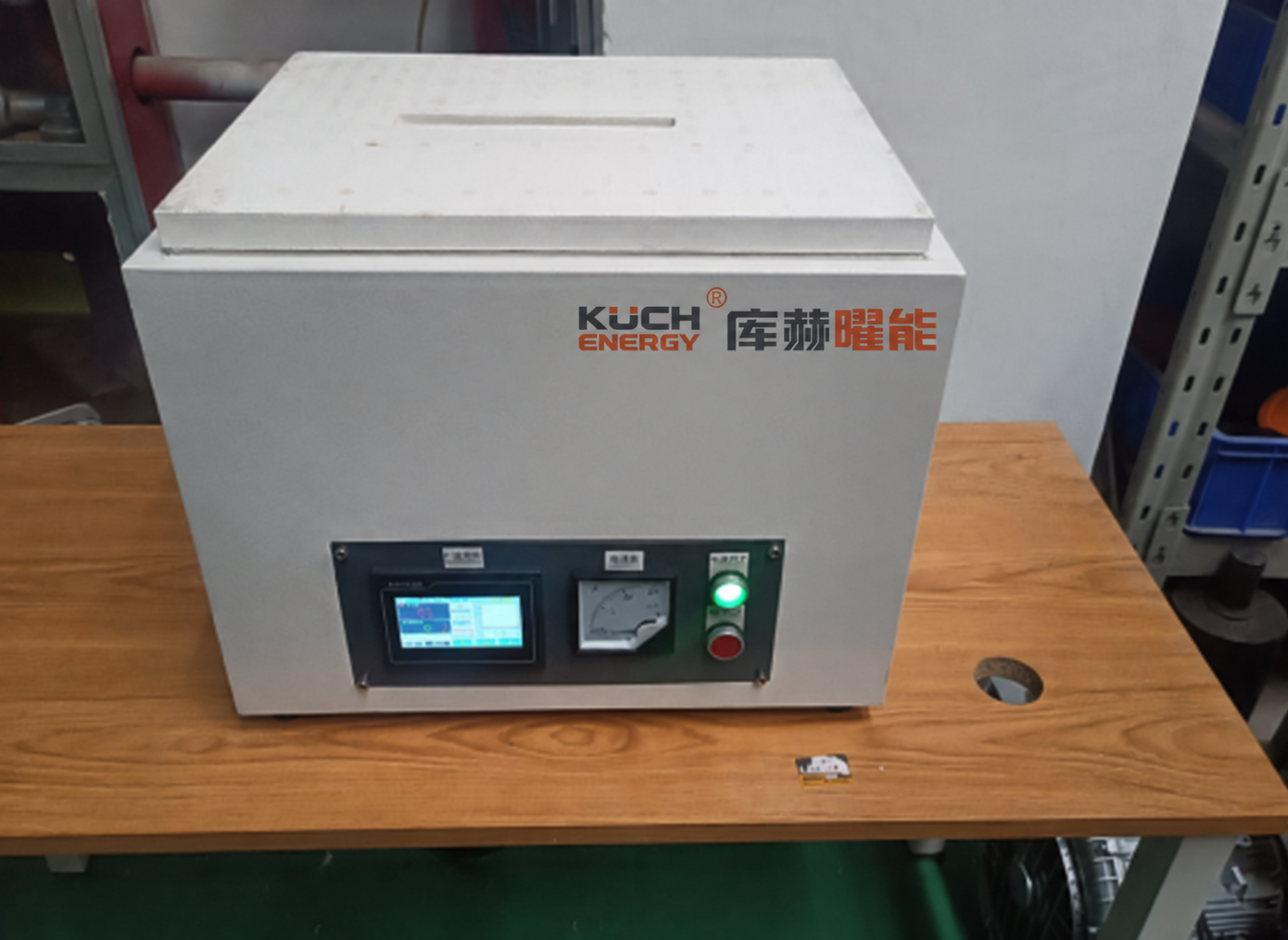
A desktop quartz lamp heating unit with four interchangeable mullite top covers and a unified touch-screen temperature control interface, designed to provide full-surface single-sided heating for elongated, square, ribbed small parts, and large-size panels. Supports cyclic temperature testing including heating, holding, cooling, re-heating, and re-holding.
Project Challenges
Four distinct specimen types—long thin strips, square samples, small stiffened components, and large panels—all require full-surface single-sided heating with support for cyclic temperature control. Using only a furnace-wide heating approach results in unclear thermal boundaries, difficult specimen swaps, and challenges in reviewing cyclic test data.
Use Device
Desktop quartz lamp heating host, quartz lamp array heat source, four types of replaceable mullite top covers, insulated furnace chamber, temperature feedback system, touchscreen temperature control interface (real-time temperature, set temperature, temperature curve, alarm query, data export)
Project Outcomes
A modular solution combining one host with four interchangeable top covers and unified temperature control enables single-side full-surface heating for multi-specimen test articles. It achieves a target temperature of 130°C or higher, a heating rate of 0.8°C/s, and a temperature control accuracy of ±2°C. The system supports cyclic processes including heating, holding, cooling, reheating, and re-holding, ensuring that the entire test process is observable, recordable, and reproducible.
Case Details
This case study presents the design and delivery of a benchtop quartz lamp surface heating system tailored for single-sided, full-surface heating of four distinct specimen types with varying sizes and structures. The system employs quartz lamp infrared radiation as its core heating mechanism, featuring four interchangeable mullite top covers to accommodate different specimens. Integrated with an insulated furnace chamber, temperature feedback control, and a touchscreen interface, it ensures stable and repeatable thermal input conditions during the heating and holding phases of cyclic temperature control processes.
This approach focuses not on simply expanding the furnace chamber, but on establishing a clear heat source layout, boundary matching, and control logic centered on the target heated surfaces of test specimens. This enables switchable testing for multi-specimen samples on a single platform.
1. Project Background: Heating Adaptation Challenges Due to Multi-Specimen Variants
In material performance validation, structural thermal response testing, and small-batch process verification, test specimens often vary in size. While early project stages may appear to simply involve "heating samples," the actual challenges become specific during the design phase: how to position different specimens, define heated surfaces, align heat sources with windows, and ensure consistent temperature profiles across all test cycles.
The test specimens in this case include long thin strips, square samples, small ribbed components, and large panels. While these specimens vary significantly in dimensions, weight, structural boundaries, heated surface area, and support methods, the customer's heating objective is consistent: to uniformly heat one entire surface of each specimen and enable subsequent cyclic temperature control testing.
This requirement cannot be simplified as "building a furnace." If the focus is solely on heating the entire chamber, excessive heat will dissipate into non-target areas, and boundary conditions during sample swaps remain ambiguous. For experiments comparing thermal responses across different batches or structures, clearer heating boundaries lead to more reproducible and analyzable data.
2. Requirement Breakdown: Why This Project Fits a Face Heating Solution
In the early requirements analysis, Kuhe Yao broke down the project's key issues into four keywords: multi-specimen testing, single-sided full-surface heating, rapid top-cover switching, and cyclic temperature control testing. The core determination is "surface heating."
Face heating is not simply about increasing power output; it involves delivering heat across a coherent, planar area to the target surface of the test specimen. Key considerations include coverage area, boundary conditions, thermal response, and stability during the insulation phase. Unlike point heating, face heating effectively covers an entire surface region. Unlike line heating, it is not confined to narrow paths. Unlike volumetric heating, it does not require controlling the entire chamber volume as the primary focus.
In this case, the customer is focused on the temperature profile of the target surface of the test specimen, not the average temperature across all internal spaces. Therefore, using a quartz lamp heating scheme concentrates heat more effectively onto the target area, minimizes wasted heating zones, and facilitates easy adapter integration for various specimens via the top cover module.
| Test Specimen Type | Typical Dimensions | Target Heat | Device Adaptation Method |
|---|---|---|---|
| Long, thin strip specimen | 200 × 25 mm | Single-sided full-surface heating | Replace the elongated window cover to match the thermal boundary of the elongated specimen. |
| Square specimen | 100 × 100 mm | Single-sided full-surface heating | Replace the square window cover to create a stable planar heating zone. |
| Ribbed small-scale test specimen | 280 × 40 mm | Single-sided full-surface heating | Replace the dedicated top cover to accommodate rib structure, support method, and window alignment. |
| Large ribbed panels | 410 × 300 mm | Single-sided full-surface heating | Replace the large panel cover to balance support, opening, and thermal insulation boundaries. |
III. Solution Design: One Host, Four Lid Types, Unified Temperature Control
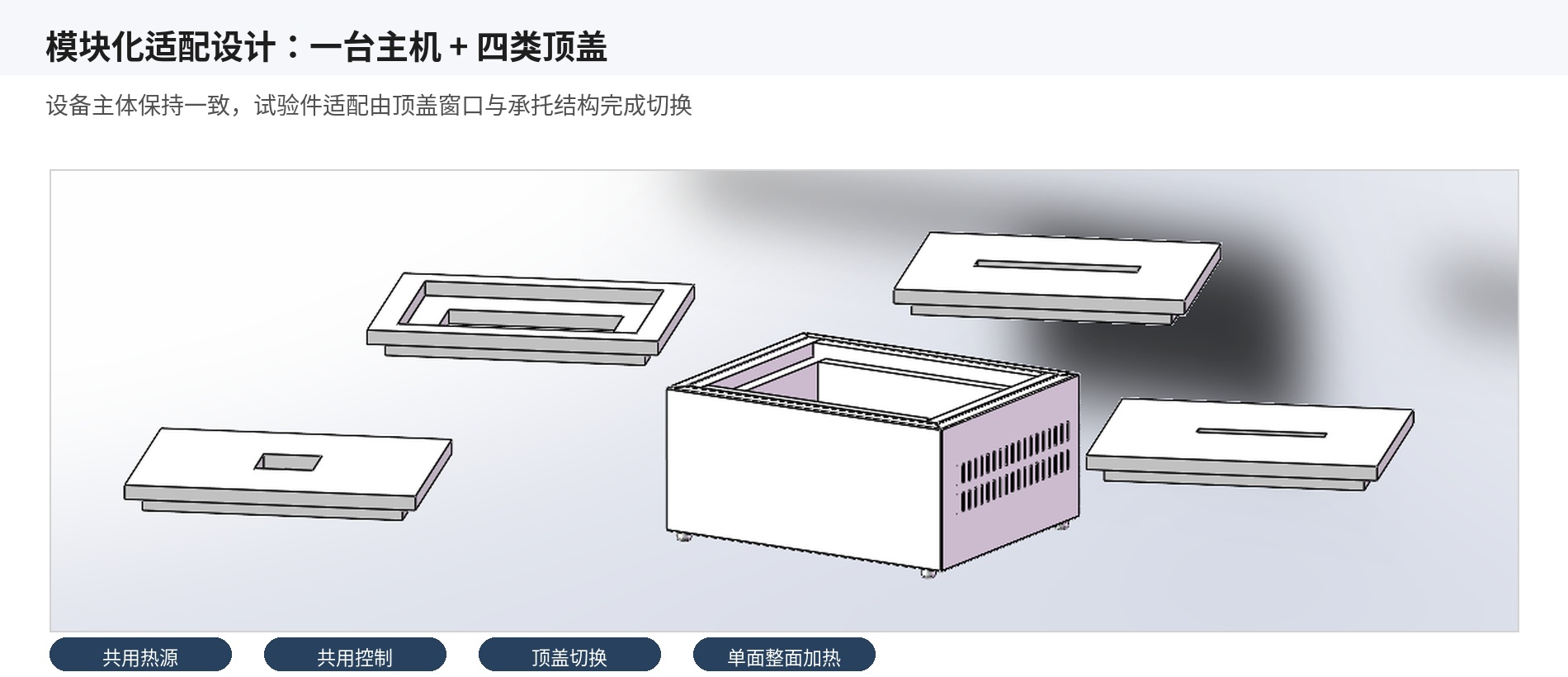
To accommodate variations across multi-specimen test articles, the project avoids configuring separate equipment for each specimen. Instead, the system is modularized into a unified main unit and interchangeable top caps. The main unit provides a stable heat source, an insulated furnace chamber, temperature feedback, and control displays. The top cap handles specimen dimensions, placement orientation, window boundaries, and support structures.
This design approach shifts the complexity of non-standard samples to the top cover module, keeping the main equipment consistent. During testing, operators select the appropriate top cover based on the sample type and align the sample placement area and heated surface boundary with the furnace's thermal field. This enables single-sided full-surface heating tests for various samples using a single equipment setup.
From an engineering perspective, a unified host eliminates redundant equipment configuration, while interchangeable top covers enhance sample adaptability. A standardized temperature control interface reduces the learning curve for operators. For laboratory cycle testing, this "fixed host, swappable top cover, adjustable parameters" approach facilitates a stable and consistent testing workflow.
IV. Implementation Path: Synergistic Matching of Heat Source, Top Cover, Furnace Chamber, and Temperature Control System
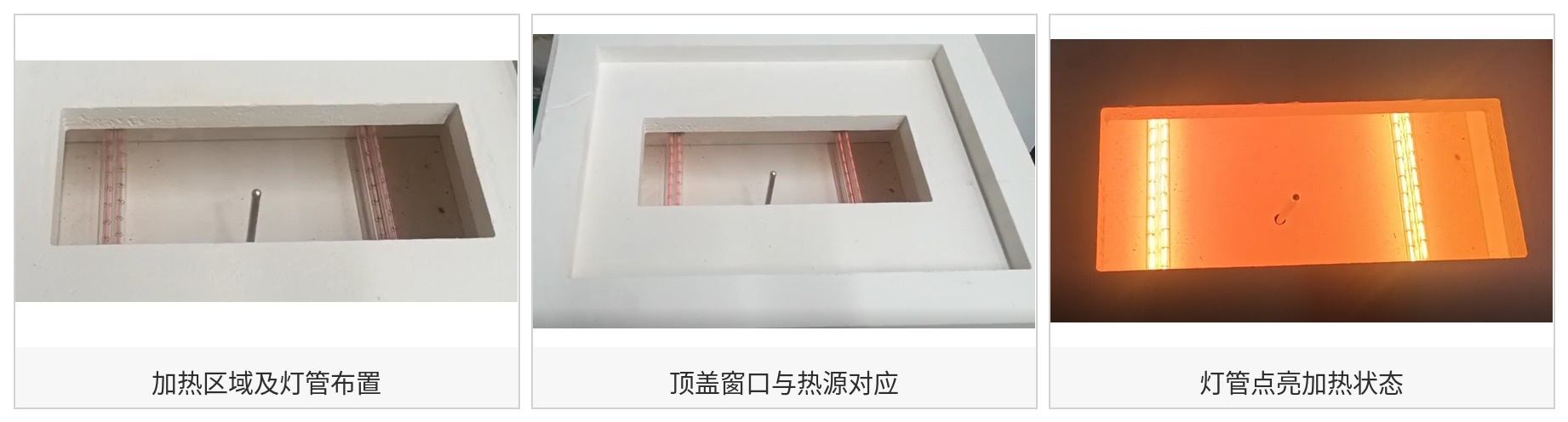
Quartz lamp radiant heating matches repeated thermal cycling: The equipment uses an array of quartz lamps as the primary heat source. When energized, the quartz lamps generate infrared radiation that heats the top test window area via internal furnace chamber layout, then transfers to the target heated surface of the specimen. Quartz lamps offer fast response, flexible on/off control, and relatively low thermal inertia, making them ideal for tests requiring controlled ramp rates, dwell times, and multiple repeat heating cycles.
The insulated furnace chamber minimizes heat loss and enhances thermal stability. Its purpose is not merely to enclose the heat source, but to prevent heat dissipation in non-target directions and provide a stable thermal environment for the specimen's heated surface. For tests requiring moderate target temperatures with high cycle counts, controlling heat loss remains critical. Through the collaborative design of the furnace chamber and top cover boundary, heat is directed more effectively toward the target surface, thereby improving stability during the insulation phase and test repeatability.
Four mullite lid types enable rapid swapping to define sample boundaries. The lid does not alter the heating target; instead, it provides tailored support, openings, and insulation based on the sample's size, structure, and placement. Mullite offers excellent high-temperature resistance and thermal insulation, making it ideal for test windows and sample supports. By swapping lids, the system can switch from long samples to square ones, or accommodate ribbed components and large panels.

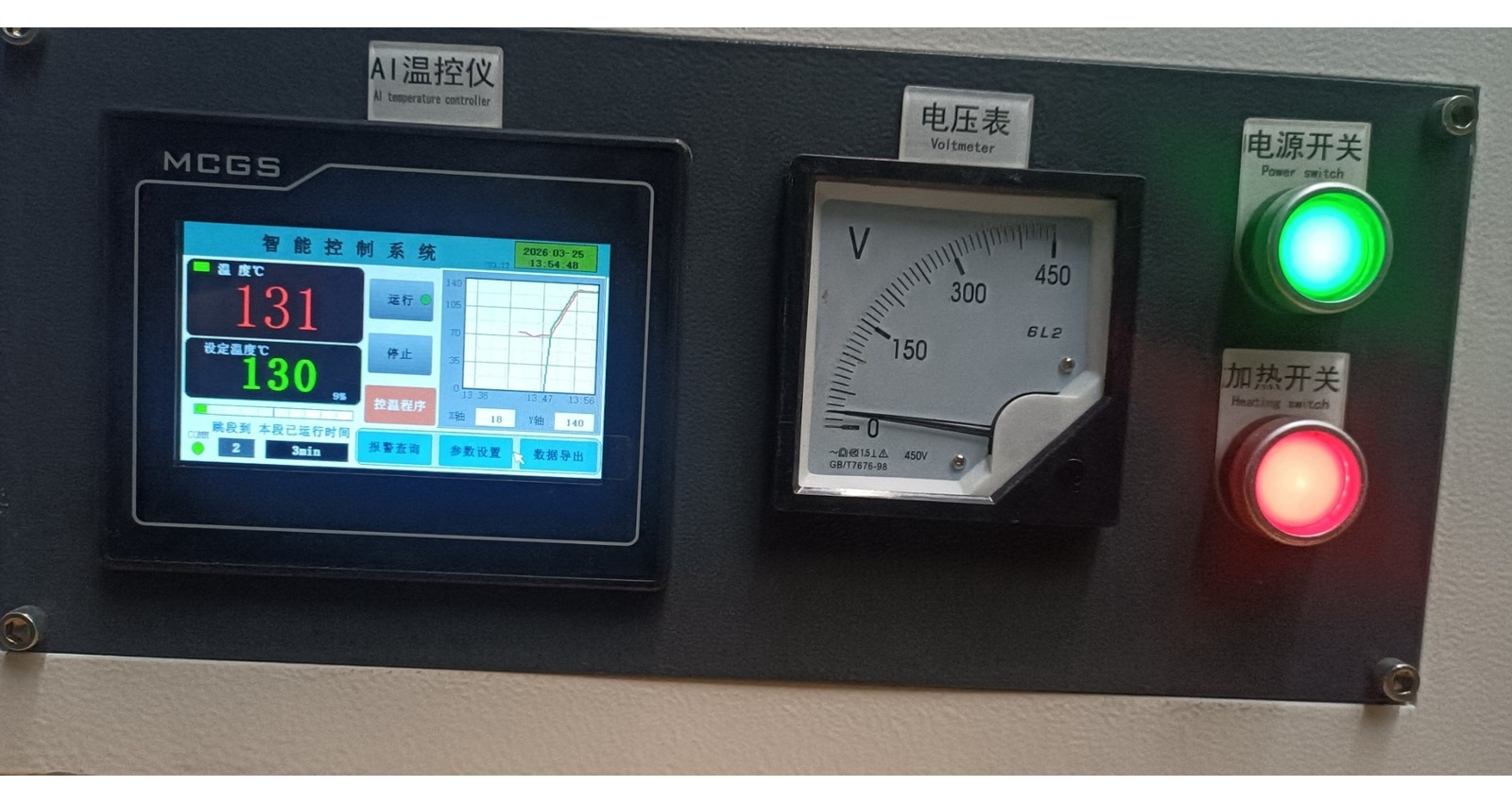
Touchscreen Temperature Control Interface for Easy Monitoring and Review of Cycles: The device front panel features a touchscreen interface that displays real-time temperature, setpoint, and temperature change curves. It supports operation controls (start/stop), parameter configuration, alarm history, and data export to manage the entire test process. For cyclic temperature testing, this visual interface does more than just show temperatures—it ensures every heating, holding, and cooling phase is fully traceable.
V. Core Parameters and Configuration Details
| Project | Settings/Metrics | Instructions |
|---|---|---|
| Device Form | Desktop Single-Side Quartz Lamp Heating Equipment | For laboratory material testing and structural component thermal response testing scenarios |
| Heating Method | Quartz lamp infrared radiant surface heating | Heat is applied to the target surface on one side of the specimen. |
| Target Devices | Four test specimens of different sizes and structures | Covers elongated, square, ribbed small parts, and large panels |
| Heat target | Single-sided full-surface heating | Match the heat transfer surface boundaries via the corresponding top cover. |
| Target temperature | 130°C or above | Meets requirements for low-temperature thermal response, preheating, heat retention, and cycling tests. |
| Heating rate | 0.8°C/s | Support setting the heating-up process and repeated heating cycles |
| Temperature Control Accuracy | ±2℃ | Improve stability during the insulation phase and repeatability in cyclic testing |
| Roof Configuration | Four Types of Replaceable Mullite Lids | Switch based on specimen size, structure, and placement |
| Control Display | Touchscreen Temperature Control Interface | Display real-time temperature, setpoint, and temperature curve |
| Workflow Support | Heat → Keep Warm → Cool Down → Reheat → Keep Warm Again | The device manages the heating and temperature-holding stages in the cyclic process. |
6. Application Process: Make Cyclic Temperature Testing Clearer
- Lid Selection and Installation: Select the appropriate lid based on the test specimen type and install it on top of the device.
- Sample Placement: Position the test specimen at the corresponding location on the top cover so that the target heated surface aligns with the quartz lamp heating zone.
- Parameter Settings: Set target temperature, heating rate, and hold time via the touchscreen.
- Heat-up and Soak: Upon startup, the quartz lamp emits radiant heat. The temperature control system adjusts heating output based on real-time feedback, ensuring the test specimen follows the programmed ramp-up profile and enters the soak phase.
- Cool-down and Recirculation: After completing one heating-and-hold cycle, the test specimen enters a cool-down phase. Once conditions for the next cycle are met, it proceeds to the subsequent heating-and-hold process.
For test operators, this workflow offers clear operational paths. While specimen sizes vary, the host system, interface, and control logic remain consistent. Although temperatures differ across cycle stages, observation and recording methods stay uniform.
VII. Capabilities Developed: From "Capable of Heating" to "Repeatable Testing"
The key advantage of this equipment isn't just reaching target temperatures—it unifies four types of custom test specimens on a single, switchable top-heating platform. With one heat source, one control system, and one user interface, plus four interchangeable top covers, it supports full-surface single-sided heating for various specimen sizes. From a value perspective, this setup eliminates redundant equipment, accelerates test preparation, and ensures consistent thermal control logic across different samples.
| Capability Dimensions | Formed capability | Match Design | Utility |
|---|---|---|---|
| Prototype coverage | One equipment body serves four types of test specimens. | Unified host, top cover switching | Reduce duplicate device configurations and improve utilization rates |
| Heating mode | Single-sided full-surface heating | Quartz lamp radiant heat source matches the window | Enhance thermal boundary clarity and operating condition consistency |
| Loop Test | Supports repeated heating and insulation cycles | Temperature Control Interface: Displays Real-Time Temperature and Curve | Easy to observe, record, and review |
| Operations & Maintenance | Clear sample switching path | Four-Category Lid Module Management | Reduce test preparation complexity |
8. Why This Is a Typical Application for Quartz Lamp Surface Heating
Spot heating addresses localized temperature rise in small areas, ideal for soldering points, micro-hotspots, and high-temperature loading of small-scale samples. Line heating handles elongated regions or continuous path heating, suitable for strip materials, sheet edges, and continuous processing scenarios. Bulk heating focuses on the overall thermal environment within a furnace or chamber.
The objective of this case is to achieve uniform heating across one entire surface of the test specimen, focusing on heat input to a specific surface area rather than a point, line, or the entire volume. Consequently, quartz lamp surface heating better aligns with the project requirements: it effectively covers the target heated area while using the top cover and insulation structure to define clear boundary conditions, avoiding an overly generic overall furnace design.
9. Scalable Application Scenarios
- Preheating of sheet materials and single-sided thermal exposure of structural components
- Surface Heating of Composite Materials and Thermal Cycling of Coated Specimens
- Thermal Response Observation of Small Structural Components
- Multi-batch Material Comparison Testing in the Lab
- Non-standard heating project with frequent specification changes for prototype parts during R&D phase
Unlike traditional furnace heating, quartz lamp surface heating emphasizes precise heat application. Compared to point or line heating, it is better suited for covering specific surface areas. For R&D projects with frequently changing sample specifications, the "standardized main unit + customizable adapter modules" approach improves solution flexibility while controlling costs.
X. Case Summary
This case study addresses the single-sided full-surface heating requirements for four distinct specimen types with varying sizes and structures. The core solution utilizes quartz lamp radiant heating, integrated with a unified heating unit, four interchangeable mullite top covers, an insulated furnace chamber, and a touch-screen temperature control interface to achieve precise heating and holding temperature control during cyclic testing of multi-specimen specimens.
It doesn't just solve a simple heating challenge. It addresses how to achieve stable heating across multiple specimen sizes on a single platform, enable rapid switching, maintain consistent control logic, and ensure that cyclic testing is observable, recordable, and reproducible. Designing custom heating equipment has never been about simply stacking specifications. The real focus lies in aligning the entire system—including the specimen, heated zones, heat source layout, insulation boundaries, temperature feedback, and operational workflow—to work seamlessly together.
Need something similar?
Our technical team delivers customized laser heating solutions tailored to your specific needs.
Contact Us